
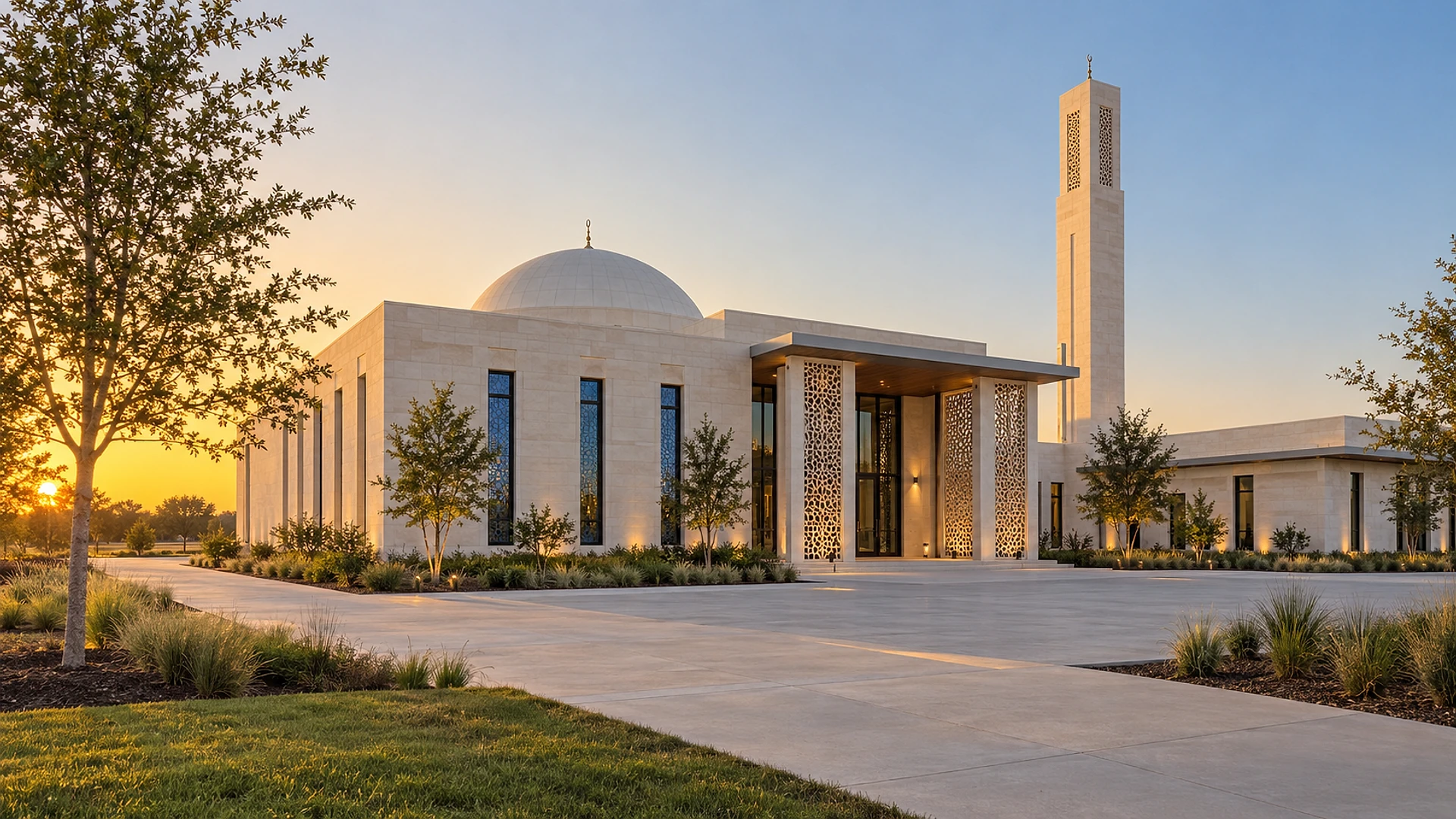
Building a mosque around Houston usually takes 3–5 years from the first land search to the first prayer in the new hall, and less than half of that time is construction. The rest goes to finding the right land, agreeing on what to build first, raising the money and getting through permits. An owner's representative — a professional who works only for the board — keeps those years from slipping.
Most mosque projects are led by a volunteer board. Its members are often doctors, engineers, teachers and business owners who give their evenings to the community, but few of them have built a public building before. The money comes from donors, a little at a time. And the building has to serve Friday prayer, Ramadan nights, Eid crowds, a weekend school and funerals — often for 50 years or more.
To show how that plays out, this article follows a hypothetical project from start to finish. The community, the site and the numbers are made up for illustration; the stages and the decisions are the real ones boards face.
Key takeaways
- Plan the whole site first, then build it in phases. Phase 1 should never block phases 2 and 3.
- Around Houston, parking and the stormwater pond often take more land than the building. Check both before you buy.
- The City of Houston has no zoning, but many nearby cities do — and federal law says they must treat a mosque as fairly as any other place where people gather.
- Build on cash in hand, not on pledges. Pledges are promises; contractors are paid in cash every month.
- A board needs 1 person who speaks for it. An owner's rep turns a room full of opinions into clear, dated decisions.
Meet the hypothetical community
Picture a community of about 400 families on Houston's northwest side. For 12 years they have prayed in a converted retail space. On Fridays the room overflows into the parking lot, and in Ramadan it overflows every night. The board has raised enough for land and a first building, and pledges for more.
Here is what they want, in the order they can afford it: a prayer hall with ablution rooms and offices, then a weekend school wing, then a community hall for events, dinners and youth programs.
- Site size
- 5 acres
- Families served
- About 400
- Phase 1 prayer hall
- 8,000 sq ft
- Planned phases
- 3
The board has 7 members and meets every 2 weeks. None of them has managed construction. That is the normal starting point, and it's exactly the situation our owner's representation service is built for: we sit on the board's side of the table, hold no construction contract, and make sure every decision is made on time, with the facts in front of the people making it.
What are the stages of building a mosque?
Every mosque project moves through the same 6 stages. The durations below are planning ranges for a project like our hypothetical one — a smaller project or ready land can move faster, and fundraising pauses can stretch any stage. Click through the stages to see what happens in each.
Stage 01 of 06 · 4–9 months
Land search and checks
Find land that allows the use, fits the parking and handles stormwater; confirm before you buy
Stage 02 of 06 · 2–4 months
Master plan
Lay out all 3 phases on the site so phase 1 is placed correctly
Stage 03 of 06 · 5–8 months
Design
Design the prayer hall in full detail, with structural, mechanical, electrical and plumbing drawings
Stage 04 of 06 · 3–6 months
Permits
City review, fire marshal review, stormwater approval and any accessibility review
Stage 05 of 06 · 2–3 months
Bids and contract
Get prices from contractors, compare them fairly and sign
Stage 06 of 06 · 12–18 months
Construction and opening
Build, inspect, fix the punch list and move in
Planning ranges, not a project quote. Timing varies with owner decisions, project complexity, and jurisdiction workload.
The board's biggest risk isn't a single stage. It's the gaps between them — the 2 months waiting for a board vote, or the 3 months a design sits while donors are called. An owner's rep's first job is to put dates on those gaps and keep the board to them.
What should a mosque board check before buying land?
In our hypothetical, the board finds 5 acres at a fair price inside the City of Houston. That matters, because the city has no zoning — a mosque isn't blocked just because of what the land is labeled. But no zoning doesn't mean no rules. Private deed restrictions recorded on the property can limit use, and the city still has rules for lots, setbacks and parking.
Just outside the city, the picture changes. Sugar Land, Katy, Pearland, Missouri City and many other cities around Houston have zoning, and a mosque may need a special approval, called a specific use permit, in some districts. If a city ever treats a mosque worse than a similar gathering place — a community center, a school or an event hall — the federal Religious Land Use and Institutionalized Persons Act (RLUIPA) is there to protect the community. It's a safeguard, not a plan. Land that simply allows the use is always the faster path.
Parking is the hidden land cost
A mosque is sized for its busiest hour, and Friday prayer is a very busy hour. The City of Houston's off-street parking rules count parking for a house of worship without fixed seats by the floor area of the main hall — for years that has been 1 space for every 40 square feet of the main hall, so confirm the current version for your site. For a prayer hall of about 6,000 square feet, that's roughly 150 spaces, and 150 spaces with drive aisles can cover well over an acre.
Then comes the stormwater pond. When you pave land, rain runs off faster, and Houston-area rules make you hold that water on site and release it slowly. The Harris County Flood Control District's design manual and the city's standards set how much. Our article on checking Houston-area land before you buy walks through ponds and flood zones in detail — the same checks apply to a mosque site.
Ask the seller for a long enough option period — the window when you can still walk away with most of your deposit — to finish these checks. A board that votes to buy before the parking and pond are drawn on the land can end up with 5 acres that only fit a 3-acre project.
Why plan all 3 phases before building 1?
The most expensive mistake a mosque board can make is building phase 1 in the wrong spot. A prayer hall placed in the middle of the land because it "looks right" can leave no room for the school wing, or force the parking to be rebuilt later. So before anyone designs the hall, we lay out all 3 phases on the site.
There's 1 fixed point in every mosque plan: the qibla, the direction of the Kaaba in Makkah that the congregation faces in prayer. The prayer hall turns to face it. Property lines around Houston rarely line up with it, so the hall often sits at an angle while the parking, drives and later buildings stay square to the property. That angle shapes everything around it, which is why it goes on the plan first.
In our hypothetical, the master plan puts the prayer hall near the front, facing the qibla, with ablution rooms and entries on the side nearest the parking. The school wing and community hall are reserved as dashed outlines. Their water, sewer and power lines are sized now and stubbed out for later, so phase 2 won't mean digging up phase 1's parking lot.
“Phase 1 is a building.
The master plan is a promise to the next generation.”
Who decides what on a mosque project?
Boards stall when everyone has a say on everything. The fix is simple to write down and hard to live by: agree who decides what, before design starts. Here's how we set it up for the hypothetical board.
The board
Approves the budget, the master plan and each phase. Votes only at set decision points.
A building committee
2–3 board members who meet weekly with the team and bring clear choices to the board.
The owner's rep
Works only for the board: runs the schedule and budget, checks bids and invoices, and reports every month.
The design team
The architect with its structural, mechanical, electrical and plumbing engineering. Designs, seals the drawings and gets permits.
The contractor
Builds the project for the contract price and warrants the work.
Donors
Kept informed with drawings and progress updates, not asked to vote on details.
A quick note on roles. Temelar works either as a mosque's architect — with architecture and engineering from one team under 1 agreement, as explained in 1 contract, not 4 — or as its owner's rep. Never both on the same project, because nobody should be the independent check on their own drawings.
What does the code require of a prayer hall?
A prayer hall is an assembly space under the building code, the same broad category as other rooms where many people gather. Because worshippers pray in close rows on the floor, a hall can legally hold a lot of people for its size. That number, called the occupant load, drives the number of exits, the width of the doors and the size of the restrooms.
It also drives fire protection. Under the International Building Code, which the City of Houston and most Texas cities use, an assembly space like this generally needs a fire sprinkler system once its occupant load reaches 300 people or its fire area passes 12,000 square feet. Our hypothetical hall passes the 300-person line easily, so sprinklers and a fire alarm go into the budget from day 1, not after the first plan review comment.
Permits in the city go through the Houston Permitting Center: building, fire, stormwater and utility reviews. Accessibility is its own question. The federal ADA exempts religious organizations from much of its public access rules, but Texas rules can still apply, so confirm how the Texas Accessibility Standards apply to your building before design starts. Our TDLR accessibility review guide explains when a state review is triggered. Either way, design for access — every community has elders and people who use wheelchairs.
Ablution rooms and sound
2 parts of a mosque need more care than their size suggests. Ablution rooms take a lot of water, drains, ventilation and durable finishes, and they're sized for the busiest prayer, not an average one. And a prayer hall with hard floors and a high ceiling can echo badly, so the sound system and the room's acoustics should be designed together.
How should a board budget and pay for phase 1?
In our hypothetical, the board has about $3.5 million in cash and $1.5 million in pledges. Many communities build without interest-based loans, so phase 1 has to fit the cash — and the pledges fund the next phase as they come in. An owner's rep builds a budget that holds every cost, not just the construction contract.
These are planning ranges, not a quote, and the pieces won't add up to exactly 100% on any single project. The line boards cut first is contingency — the money set aside for surprises. It's also the line they miss most in month 14, when the soil turns out to be wetter than expected.
| Decision | Board on its ownVolunteers, part time | With an owner's repWorks only for the board |
|---|---|---|
| Picking a contractor | Lowest price wins. | Bids compared line by line for what's missing. |
| Monthly invoices | Treasurer approves the total. | Work checked on site before payment. |
| Change orders | Approved at the next meeting. | Reviewed in days, with a fair price. |
| Donor updates | Whoever has time. | Monthly report with photos and budget. |
| Board votes | Open-ended discussion. | Clear options, a due date and a recommendation. |
What happens during construction and opening?
Construction on our hypothetical phase 1 runs about 14 months. The owner's rep attends the weekly site meeting, reviews every monthly invoice against the work actually in place, and brings any change in cost or time to the building committee within days, not weeks. The board gets 1 short report a month with photos, budget and schedule.
The last 2 months are the ones boards underestimate. Inspections, the fire marshal's final test, the punch list — the list of small items the contractor must fix — and the handover of manuals and warranties all take time. We plan the opening prayer after the certificate of occupancy, the city's approval to use the building, not before it. Announcing an Eid opening date before that approval is in hand is a risk no board needs to take.
When the hall opens, the work for phases 2 and 3 is already set up: the land is reserved, the utilities are stubbed and the drawings for the whole site exist. The next phase starts when the money does. You can see more of how we plan schools, mosques and community buildings on our institutional sector page.
Frequently asked questions
For a new building on new land, plan on 3–5 years from the land search to opening. Construction itself is often 12–18 months. The rest is land checks, planning, design, permits and fundraising, and the board's decision speed affects that more than anything else.
It depends on the size of the prayer hall, parking rules and the stormwater pond. Parking often takes more land than the building. A community planning a 6,000–8,000 square foot prayer hall with room to grow often looks at 3–6 acres, but a site check is the only way to know.
The City of Houston has no zoning, though deed restrictions, lot rules and parking rules still apply. Many surrounding cities do have zoning and may require a special approval in some districts. Always confirm which city the land is in before you buy.
An owner's rep is a professional who works only for the owner — here, the mosque board. They manage the schedule and budget, compare contractor bids, check invoices and change orders, and report to the board. They hold no construction contract, so their advice is independent.
Yes, and most communities do. The key is a master plan for the whole site first, so the first building sits in the right spot and utilities are sized for later phases. That way phase 2 doesn't mean tearing up phase 1.
Often, yes. Under the building code most Texas cities use, an assembly space generally needs sprinklers once it holds 300 or more people or its fire area passes 12,000 square feet. Prayer halls fill densely, so many pass that line even at modest sizes.
The federal ADA exempts religious organizations from much of its public access rules, but Texas rules and the local building code can still apply. Confirm how the Texas Accessibility Standards apply before design starts, and plan for full access regardless.
It's safer not to. Pledges are promises, and contractors are paid every month. Size each phase to the cash you have, and let pledges fund the next phase as they arrive.
Before buying land. The most costly decisions — which land, how much parking, where the first building goes — are made at the start, when changing course is still cheap.
Planning a mosque or Islamic center?
If your board is looking at land, planning a first building or stuck between phases, tell us about your community, your site and your budget through our contact page. We'll tell you which stage you're really in and what decision the board needs to make next.
