
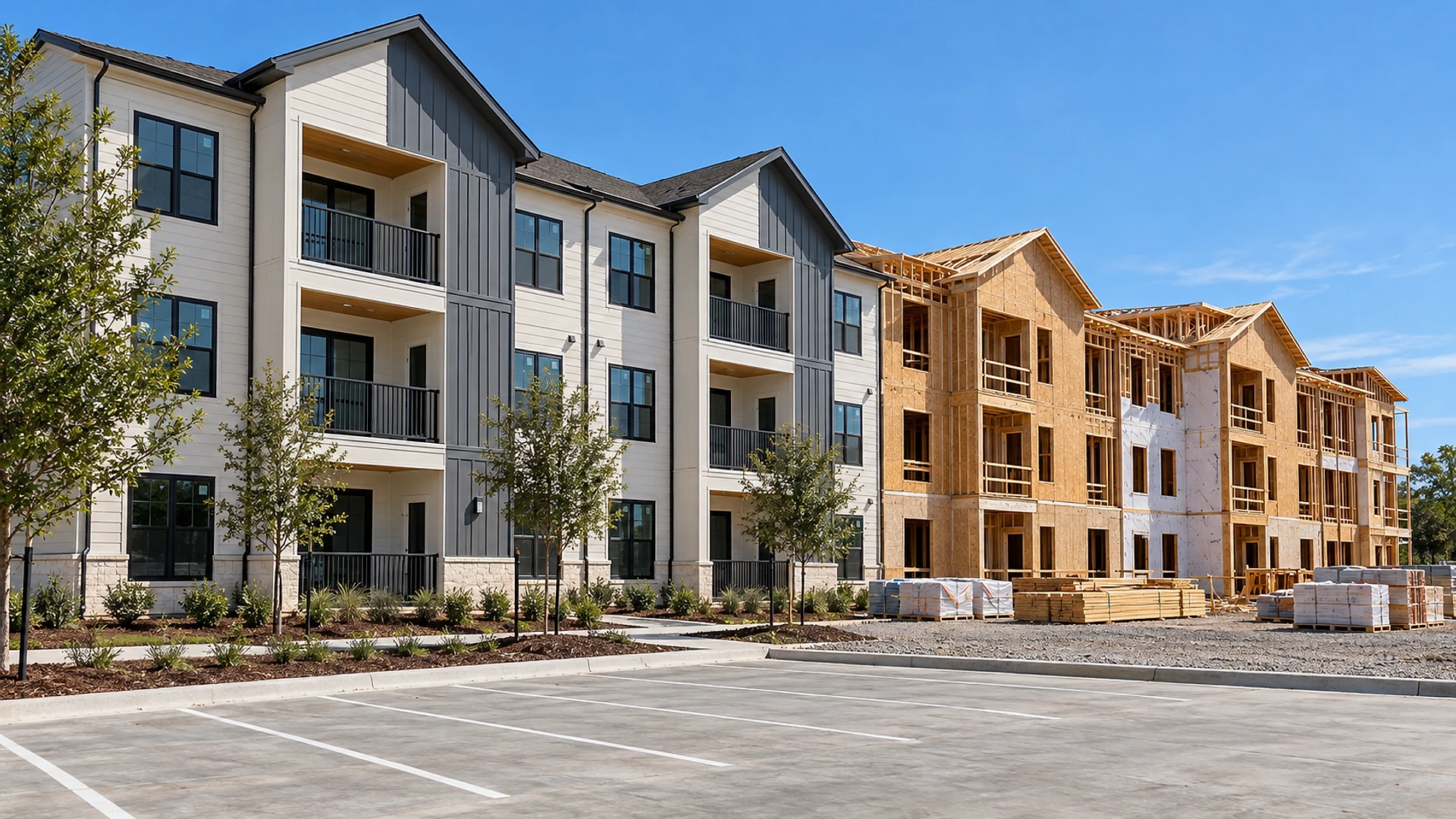
Reviewing a contractor's pay application on a Texas apartment build means checking the monthly bill line by line against the work actually in place, holding back 10% as retainage, collecting the right lien waivers, and paying the approved amount within 35 days. Done every month, those 4 habits protect you from paying for work that isn't there and from liens filed by unpaid subcontractors.
A pay application is the contractor's monthly invoice on a construction project. On an apartment job it usually arrives as a summary page plus a detailed sheet that splits the contract into lines: site work, foundations, framing, roofing, plumbing, electrical, cabinets, finishes and so on. Each line shows how much of that work the contractor says is done.
Most owners sign the first few without much trouble. The trouble usually shows up in month 8 or 9, when the building looks almost finished, most of the money is gone, and the hardest work is still ahead. This article walks through the 7 steps we follow in our owner's representation service so that never happens. It's written for apartment owners and developers anywhere in Texas. It isn't legal advice, and your contract and attorney have the final word.
Key takeaways
- Agree on the bill's line items before work starts. A clear breakdown of the contract makes every monthly check faster and fairer.
- Walk the site before you approve a dollar. Compare each line of the bill to the work you can see, not to the calendar.
- Hold back 10%. Texas law requires owners to keep 10% of the work's value until 30 days after the work is complete.
- Swap lien waivers every month. Get a conditional waiver for this payment and an unconditional one for last month's.
- Pay on time. Texas generally gives you 35 days to pay an approved request, and you may hold back only the amount you dispute in good faith.
- Pay applications on a typical build
- 14-24
- Retainage Texas owners must hold
- 10%
- Days to pay an approved request
- 35
- Retainage kept after completion
- 30 days
What is a pay application, and who checks it?
On most apartment projects the contractor submits 1 pay application a month, usually on the standard American Institute of Architects form called the G702, with its G703 continuation sheet. The G702 is the cover page with the totals. The G703 is the detail: every line of the contract, what has been billed before, what is billed now, and what materials are stored and waiting to be installed.
Someone on the owner's side has to check that bill before money moves. On a traditional project, the architect certifies the payment, which means signing to say the work billed appears to be done. When the owner also has an owner's rep, that person runs the whole review: the site walk, the paperwork and the conversation with the contractor. On our projects, architecture and engineering come from one team, so the people who drew the building know what each line should look like in the field.
The review takes 7 steps. The first 2 happen before construction starts, and the rest repeat every month until the final payment.
- 01
Set up the schedule of values
agree on the bill's line items before the first request
- 02
Review a draft first
a marked-up draft saves a week of back and forth
- 03
Walk the site against the bill
every line checked against the work in place
- 04
Check changes and stored materials
only approved changes, only protected materials
- 05
Hold the retainage
10% stays with you until 30 days after completion
- 06
Swap the lien waivers
conditional for this payment, unconditional for the last one
- 07
Certify and pay on time
the approved amount within 35 days
How should the bill be broken down before work starts?
The breakdown is called the schedule of values: a list that splits the contract price into pieces of work, each with its own dollar amount. It's the backbone of every bill that follows, so we agree on it with the contractor before the first request, not after.
On an apartment project, we ask for a schedule that follows the way the building is actually built. If the project has 4 buildings and a clubhouse, each building gets its own lines, so you can see that Building 3's framing is billed separately from Building 1's. We ask that big trades like framing, plumbing and electrical be split into rough work (the hidden pipes and wires inside the walls) and finish work (fixtures, devices and trim), because those happen months apart.
We also look for front-loading, which means putting too much money on the early lines, like site work and foundations, and too little on the late ones, like finishes and paving. It helps the contractor's cash flow early on, but it leaves the owner with too little money in the contract to finish the job if something goes wrong late. A fair schedule puts each line close to its real cost. If you want to see how building type changes those costs, our guide to garden, wrap and podium apartment buildings breaks them down.
Why ask for a draft before the real bill?
Many contractors will send a draft, often called a pencil copy, about a week before the formal request. We go through it, mark up any line that looks ahead of the work, and send it back. The contractor fixes it and then submits the final version.
This saves time for everyone. Without a draft, the owner rejects a finished request, the contractor redoes it, and the 35-day clock under Texas law gets harder to track. With a draft, the formal bill usually arrives already agreed, and approval takes a day or 2 instead of 2 weeks.
How do you check the bill against the work on site?
This is the core of the review. We walk the site with the draft in hand and compare every line to what is actually built. If the bill says the framing in Building 2 is 85% done, the roof trusses should be up, the walls sheathed and the stairs in. If the trusses are still on the ground, the line is ahead of the work.
On an apartment build we walk every building, not just the one by the trailer. Overbilling is rarely on purpose: a superintendent estimates from memory, or a subcontractor bills a full floor when half is done.
Most lines that run ahead are honest guesses that came out high. We trim them back to the work in place and the contractor bills the difference next month, once the work is there. Nobody loses money; the owner simply stops paying early.
We also watch the total. If 70% of the contract has been billed but only half the building looks finished, the money left may not cover what's left to build. That gap is a warning sign worth raising early, while there's still time to fix it.
What about change orders and stored materials?
2 parts of every bill need a closer look than the rest.
Change orders
A change order is a signed agreement that changes the contract's scope, price or time. Only approved, signed change orders belong on the bill. We often see "pending" changes, ones still being priced or argued about, slipped in as their own line. We take those out until they are signed. The same goes for allowances, which are placeholder amounts in the contract for items not yet chosen, like appliances or flooring. The bill should show what was actually spent against each allowance.
Stored materials
Apartment jobs buy a lot of material early: cabinets, appliances, windows, doors and plumbing fixtures. Contracts usually let the contractor bill for materials that are delivered but not installed yet, but only if they are protected. We ask for the invoice, proof of insurance, and photos showing the materials are dry, secure and labeled for this project. For materials stored off site, we go and look. Cabinets sitting in the rain under a tarp aren't "suitably stored," whatever the bill says.
How much should you hold back, and for how long?
Retainage is money the owner holds back from each payment until the end of the job. In Texas it isn't optional. Chapter 53 of the Texas Property Code requires the owner to hold 10% of the contract price, or 10% of the value of the work done, during the work and for 30 days after it is complete.
The reason is protection. If a subcontractor or supplier goes unpaid, they can file a lien, which is a legal claim against your property. Retained money is what pays valid claims. If you don't hold it, the law can make you responsible, up to the amount you should have kept. On an apartment project worth $10 million or more, that's a lot of money to be exposed on.
- Retainage held near the end of the build$1,100,000–$1,200,00010% of the work done, kept until 30 days after completion
- A typical busy month's bill$720,000–$1,200,000About 6–10% of the contract in a peak month
- Early billing we often trim back$120,000–$360,000Lines billed ahead of the work in the first months
- Monthly reviews over the build14–24 reviews1 a month, plus the final payment
Planning ranges only, for a garden-style or wrap apartment project. Your contract sets the exact retainage terms; Texas law sets the floor at 10% for 30 days after completion.
Planning ranges, not a project quote. Cost and timing vary with owner decisions, project complexity, market conditions, and jurisdiction workload.
Some owners agree with their contractor to release part of the retainage early, for example once a building is finished. Be careful here. The 10% rule protects you against liens, and releasing it early can leave you exposed. If you want to do it, talk to your attorney first and collect final lien waivers from everyone who worked on that part of the job before you release a dollar.
Which lien waivers should come with each payment?
A lien waiver is a signed form in which a contractor, subcontractor or supplier gives up their right to file a lien for a certain amount. Texas law sets out 4 required forms: conditional and unconditional, each for progress payments and the final payment. A waiver that doesn't substantially follow the statutory form isn't enforceable, so homemade versions don't protect you.
The difference between conditional and unconditional is simple. A conditional waiver only takes effect once the payment actually clears. An unconditional waiver takes effect immediately, and Texas law forbids asking for one until the person has actually been paid.
| Question | Conditional waiver | Unconditional waiver |
|---|---|---|
| When you collect it | With this month's pay application | With next month's application, for this month's payment |
| When it takes effect | Only once the payment clears | As soon as it is signed |
| Can you ask for it before paying? | Yes, that is what it is for | No, Texas law forbids it until they are paid |
| What it proves | They will release their rights once paid | They were paid and have released their rights |
| Who signs | The contractor and major subcontractors and suppliers | The same people, 1 month later |
So the monthly rhythm is: a conditional waiver with this month's request, and an unconditional waiver with next month's request, covering the payment just made. We ask for waivers from the contractor and from the larger subcontractors and suppliers too, such as framing, plumbing, electrical, roofing and the window supplier. Their signatures are the ones that protect you if the contractor doesn't pay them.
Texas also treats construction payments as trust funds under Chapter 162 of the Property Code, which means the contractor holds the money you pay for the benefit of the people who did the work. It doesn't replace your own waivers.
When do you have to pay, and what can you hold back?
Under the Texas Prompt Payment Act in Chapter 28, an owner who receives a written payment request for properly done work generally has to pay it within 35 days. The contractor then has 7 days to pay its subcontractors their share. If the owner doesn't pay the undisputed amount on time, the contractor can give written notice and stop work 10 days later.
You don't have to pay for work you dispute. On a commercial project such as an apartment building, the law lets an owner with a good-faith dispute hold back up to the disputed amount, and no more. That's why the review matters: a written list of which lines were trimmed and why is what turns "I'm not sure" into a good-faith dispute. Holding a whole payment because 1 line looks wrong is the fastest way to lose a good contractor and slow your project.
“Pay for the work you can see.
Hold only what you can explain.”
The final payment
The last bill is different. It releases the retainage, so it gets a full closeout check, and we don't certify it until every item below is in hand. The 30-day retainage clock starts when the work is complete, and many owners file an affidavit of completion with the county clerk to fix that date on the record. Our article on comparing contractor bids explains how retainage terms should be set in the contract in the first place.
- Every building passed final inspection and has its certificate of occupancy
- The punch list (the list of small fixes) is complete and signed off
- All change orders are signed and the contract total is final
- Unconditional final waivers from the contractor and major subcontractors
- Conditional final waiver from the contractor for this payment
- Warranties, equipment manuals and spare materials handed over
- As-built drawings showing what was actually installed
- 30 days have passed since completion, or the lien period has been confirmed
Frequently asked questions
A pay application is the contractor's monthly bill on a construction project. It lists every part of the contract, how much of each is done, materials stored on site, approved changes, and the amount requested this month. On most commercial projects it uses the standard AIA G702 and G703 forms or something very similar.
Texas law requires the owner to hold back 10% of the contract price, or 10% of the value of the work done, while the work is underway and for 30 days after it is complete. The money protects the owner if a subcontractor or supplier goes unpaid and files a lien.
Under the Texas Prompt Payment Act, an owner generally has 35 days to pay a written payment request for properly performed work. If you dispute part of the bill in good faith, you can hold back the disputed amount. Pay the rest on time so the contractor has no reason to stop work.
A conditional lien waiver releases lien rights only once the payment actually clears, so you can collect it before you pay. An unconditional waiver releases them immediately, and Texas law forbids requiring one until the person has been paid. Most owners collect a conditional waiver with each request and an unconditional one the following month.
Yes. Texas sets out 4 statutory forms for progress and final payments, conditional and unconditional. A waiver that doesn't substantially follow the right form isn't enforceable.
You can, if the contract allows it and the materials are protected. Ask for the supplier invoice, proof of insurance, photos and the storage address, and make sure the materials are clearly marked for your project. For large amounts, it's worth sending someone to look before you pay.
Mark the line back to the work actually in place and pay the rest of the bill on time. Put your reasons in writing, line by line. The contractor can bill the difference next month once the work is there, so nobody loses money and you stop paying ahead.
Not always, but on an apartment project worth several million dollars, an experienced reviewer usually pays for themselves. They know what each stage of work should look like, how to spot front-loading, and which paperwork protects you. Commercial owners in Texas use an owner's rep when they don't have a construction manager on staff.
Starting an apartment build and want every bill checked?
Monthly pay applications are where an apartment budget is quietly won or lost. We review them as part of our owner's representation work, and as the architect of record when we've designed the building, with architecture and engineering from one team either way.
If you're planning or building an apartment project in Texas, see how we work across the multifamily sector, or read how 1 agreement for design and engineering keeps the paperwork simpler. When you're ready to talk about your project, get in touch.
