
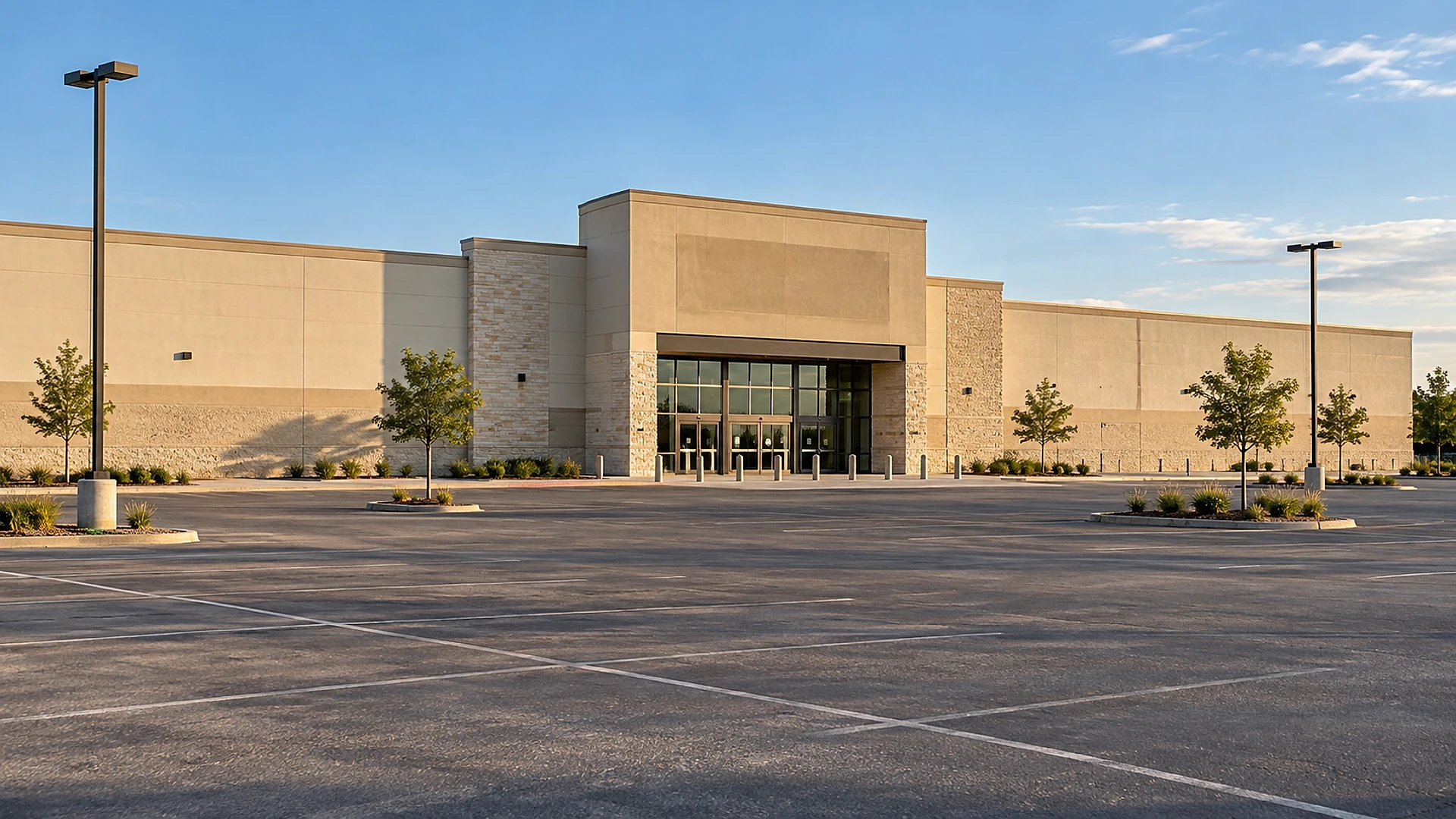
An empty big-box store gives you 3 real paths: re-lease it whole, split it into smaller shops, or tear part of it down and add small buildings along the street. Re-leasing costs the least but only works if 1 large tenant fits the building. Splitting costs more but spreads your risk across many tenants. Rebuilding costs the most and changes the most. Zoning, parking, your lease or deed rules and the numbers decide which paths are really open to you.
Big boxes are hard to fill because they were built for 1 giant user. Many are 80,000 to 150,000 square feet, with few windows, a huge roof and a parking lot sized for holiday crowds.
This guide is for owners and investors who now hold an empty store, or are thinking of buying one, anywhere in Texas. It's the kind of question we answer in our feasibility work for retail owners: which path fits, what it needs, and what it might cost, before you spend on drawings or sign a lease.
Key takeaways
- Start with the rules, not the rent. Zoning, deed rules and parking can close a path before you price it.
- Re-leasing whole is cheapest but riskiest. It depends on 1 tenant who needs a box this size, and that tenant may take a long time to appear.
- Splitting is where most of the work hides. New walls, new front doors, separate meters, restrooms and fire sprinklers all add up.
- Parking counts change with use. A restaurant needs far more spaces than a shop, so the mix of tenants is limited by the lot.
- Test all 3 paths on paper first. A few weeks of test fits and rough pricing costs a small share of what a wrong choice does.
What are your real options for an empty big box?
You can keep the building whole, cut it into pieces, or shrink it. Each has a different amount of building work and a different kind of risk.
Path A: re-lease it whole. You find 1 large tenant that wants a box this size, such as a fitness operator, a furniture store, a grocery store, a school or a training center. Work is lighter: repairs, a refreshed front, and whatever the new tenant needs inside. The risk is waiting. If no large tenant is looking, you carry the building with no rent.
Path B: split it into shops. You build walls inside the box to make smaller spaces, usually called demising (dividing 1 space into several leasable ones). Each shop needs its own front door, rear exit, electric meter, water, restrooms and air conditioning. Rent per square foot is often higher for small shops, and losing 1 tenant hurts less. The price is more building work up front, before you have signed tenants.
Path C: shrink it and add pads. You tear down part of the building, often the back or a side, and use the freed land for small buildings near the street, called pads (little building sites along the road, often for drive-thrus, clinics or quick shops). This changes the site the most, so it brings the longest review and the highest cost.
Some owners mix them: half the box for 1 large tenant, the other half split into shops, plus 1 pad.
The bigger the building, the fewer tenants can use it whole. If there is no large user in your market within a year or so of looking, Path A is a hope, not a plan. Ask a local retail broker for real examples of boxes your size that leased, how long they sat, and what they leased for.
What can stop you before you start?
Check 4 things before you draw anything: zoning, deed rules, parking and the building code. Any of them can close a path.
Zoning says what uses the land allows. In Texas, cities decide this under state law on municipal zoning, so rules differ town to town. Some places let you add shops, clinics or a school without a hearing. Others need a zoning change or a special permit, which adds months. If the store sits outside any city's zoning, county and deed rules do more of the work.
Deed rules often matter more than zoning on a big box. Many were built as part of a shopping center with a shared agreement, sometimes called a reciprocal easement agreement. It can limit what uses are allowed, who must approve changes to the front of the building, and who owns the parking. The former anchor tenant may have negotiated rules that still apply, such as a ban on competing uses. Pull every recorded document before you pay for any design.
Parking is where Path B and Path C are most often squeezed. Cities count required spaces by use. Shops need fewer spaces per 1,000 square feet than restaurants, and clinics and gyms often need more than shops. When you change the mix, the count changes. A big lot can look like it has plenty, then fall short once a few restaurant tenants move in. Ask for the count for every use you're considering, not just retail.
The building code applies differently when you change an existing building. Texas cities generally use the International Building Code and a companion code for existing buildings, with local changes. Splitting a box can trigger new rules for exits, fire walls between spaces, restrooms and sprinklers. The exact rules depend on the city's code edition and how the work is set up, which is why we confirm them early.
- Recorded deed, restrictions and any shared agreement
- Zoning district and allowed uses
- Parking required for each use you're considering
- Fire sprinkler drawings and last inspection record
- Roof age and air-conditioning unit ages
- Utility service size and meter locations
- Original drawings, if the former tenant still has them
- Any leftover lease rules from the former anchor
How much does each path cost?
Path A is the cheapest to build, Path B is in the middle, and Path C costs the most. But the cheapest path is only cheap if a tenant exists, so think in cost per rentable square foot of income, not just construction cost.
The ranges below are planning numbers for work to the shell and site, before any tenant's own interior finish. Real prices depend on the building's condition, the city, roof and utility work, and the market when you bid.
The Path C range is higher because it counts new building and site work, not just changes to what's there. Demolition alone is not the biggest part. New outer walls where you cut, new utilities, new drainage and new paving usually are.
Why Path B costs more than people expect
A new wall between 2 shops looks simple on a plan. In the building, it runs up to the roof deck and has to fit around sprinkler pipes, ducts and lights. Each shop also needs its own front door, rear door, electric meter and often its own air-conditioning unit. A big box usually has 1 electric service and a handful of large rooftop units, which have to be split and re-fed. Water lines and restrooms add more.
What about the tenant's own finish?
Most owners deliver a shell, and each tenant builds out the inside, often with an allowance from you. The allowance can be as large as your own building work, so include it in your math. Our guide on who builds what in a Texas retail lease shows where the owner's work ends and the tenant's begins.
Who actually rents a former big box?
Think about who needs a lot of space and a lot of parking, and who benefits from a low rent. In Texas, former big boxes have gone to fitness clubs, grocery stores, discount stores, furniture stores, medical groups, charter and private schools, training centers, entertainment operators and self storage. McAllen even turned a closed store into its main library.
Before you chase any tenant type, check that the lot has their parking and the zoning allows them. A school or clinic can be a strong tenant, but each needs its own approvals. We cover the extra steps in our article on an empty store becoming a dialysis clinic in a different setting.
“Don't ask who might rent the box.
Ask who the lot, the rules and the roof will allow.”
What does the research say about repositioned boxes?
Studies of vacant boxes are limited, but one is worth knowing. An MIT thesis on Texas big boxes found that, on average, rents fell further for freestanding boxes that were repositioned than for boxes that were part of a multi-tenant center. It also found that sites where the old building was torn down and a new one built saw the largest increase in assessed value.
Treat that as direction, not a promise: it's a single, older study. The lesson still holds. A box inside a busy center borrows traffic from its neighbors; a lone box has to create its own.
How long does it take to get from empty to rent?
Plan on many months, not weeks. Path B is the most common, so the tracker below walks through it. Path A is shorter. Path C is longer.
Stage 01 of 06 · 3 to 6 weeks
Rules check
zoning, deed rules, parking count
Stage 02 of 06 · 2 to 4 weeks
Test fits
2 or 3 split layouts with rough pricing
Stage 03 of 06 · 2 to 4 months
Design and engineering
drawings for walls, utilities, fronts and sprinklers
Stage 04 of 06 · 1 to 4 months
Permit review
varies a lot by city and by whether a hearing is needed
Stage 05 of 06 · 4 to 9 months
Base building work
new walls, meters, restrooms, fronts
Stage 06 of 06 · 2 to 5 months
Tenant finish
each tenant builds out its own space
Planning ranges, not a project quote. Timing varies with owner decisions, project complexity, and jurisdiction workload.
Steps overlap. Many owners start tenant talks during design, so keep early drawings flexible.
Every duration and cost in this article is a planning range for thinking and budgeting, not a quote or a promise. Your building's condition, your city's review pace and the construction market on the day you bid will move them.
How do you choose between the 3 paths?
Run through these questions in order. Stop when one of them settles it.
- Do the rules allow the path? If the deed or zoning blocks it, it's out until that changes.
- Is there a real large tenant? A signed letter of intent from a large user makes Path A attractive. A hope does not.
- Does the lot have enough parking for the mix you want? If not, you may need Path C, or fewer restaurant-type users.
- Is the roof and the building's frame in good shape? A bad roof raises the cost of every path.
- What can you carry? Path B and Path C mean spending before income starts. Be honest about how long your finances can hold out.
With no large tenant, rules that allow shops and parking to spare, owners usually land on Path B.
How we help an owner decide
Our architecture and permitting team draws the 3 layouts on the real building, checks each against the rules and gives you a plain-language comparison with planning ranges. Architecture and engineering come from one team, so the structure, fire sprinklers, electrical and air conditioning are checked against the same drawings. That keeps the test fit honest, because the walls we draw can actually be built. If you also need to plan the tenant side, our tenant improvement work covers it.
- 01
Site and records
deed, zoning, utilities, roof
- 02
Rules check
uses, parking, code triggers
- 03
3 test fits
A, B and C drawn on the real plan
- 04
Rough pricing
planning ranges for each path
- 05
Decision
1 path, then full design
Do you have to update accessibility when you split a box?
Usually yes, to some degree. Texas requires design review and inspection for many commercial projects through the Texas Department of Licensing and Regulation, and projects above a cost threshold must be registered with it before construction. The threshold is set by TDLR's accessibility program, so check the current number for your project. Federal rules, set out in the 2010 ADA Standards, shape parking, routes, doors and restrooms.
Splitting a box creates new entrances and restrooms, and each has to work for everyone. It's far cheaper to draw accessible routes, doors and restrooms in at the start than to fix them after a review comment.
What happens to the sprinkler system?
Big boxes almost always have a sprinkler system. When you split the space, the pipes and heads may need to be rearranged so each shop is covered, and the system's design may need to match what each tenant stores and sells. The national standard that covers how sprinklers are designed is NFPA 13. A tenant that stores tall stacks of goods can need more water than one that sells clothes, and the existing system may have been designed for something else.
Ask for the last sprinkler inspection report early, before you promise tenants anything. Projects like a strip center facade refresh show how a small-looking change can trigger bigger work, and splitting a box does the same thing more strongly.
Questions owners ask about empty big-box stores
How much does it cost to split a big-box store into smaller spaces?
For planning, owner's work to create shells, meaning new walls, fronts, meters, restrooms and utilities before tenant finish, often runs roughly $40 to $90 per square foot of building. A worn roof, an old electrical service or a sprinkler redesign can push it higher. Get a test fit and rough pricing before you commit.
Can a former big-box store be turned into a school or clinic?
Often yes, but each use brings its own approvals, parking counts and building work. A school or clinic can be a strong tenant for a large, open space, but plan for added review time. Check zoning and deed rules before you spend on design.
How long does it take to redevelop an empty big box in Texas?
Plan on roughly 10 to 20 months from the first rules check to the first tenant opening for a split. Light re-leasing can be faster if a tenant fits as-is. Partial demolition and new pads usually take longer, because the site review is bigger.
What is demising?
Demising means building walls to divide 1 large space into several smaller ones that can each be leased on its own. It's the biggest piece of work in turning a big box into shops.
Is it cheaper to tear down a big box or reuse it?
Reusing the building usually costs less per square foot than rebuilding, but not always. If the roof, structure or utilities are in bad shape, or the floor plate is awkward for any tenant, new construction can compete. Compare both on paper, including the tenant allowances, before deciding.
What approvals do I need to split a retail building?
You normally need a building permit, and many cities also review the site plan, parking and fire protection. Accessibility review applies above a cost threshold. If the zoning does not allow the new uses, you may also need a zoning change or special permit. We map these early so there are no surprises.
Do I need the former tenant's permission to change the building?
Sometimes. If the box sits in a shopping center with a shared agreement, or the former tenant has leftover rights, you may need approvals for changes to the front, the parking or the allowed uses. Read the recorded documents first.
Who builds the inside of each shop after I split the box?
Usually the tenant builds the interior, often with an allowance from the owner, while the owner delivers the shell. The line between the 2 is set in each lease, so draw it clearly before you negotiate.
Own an empty box? Test all 3 paths before you choose
An empty box costs money every month, but a wrong move costs more. A few weeks of rules checks, test fits and rough pricing show you which paths are real and which are hopes.
If you hold a vacant store, or are weighing whether to buy one, contact us with the address and what you know about the building. We'll tell you plainly what we can check first.
