
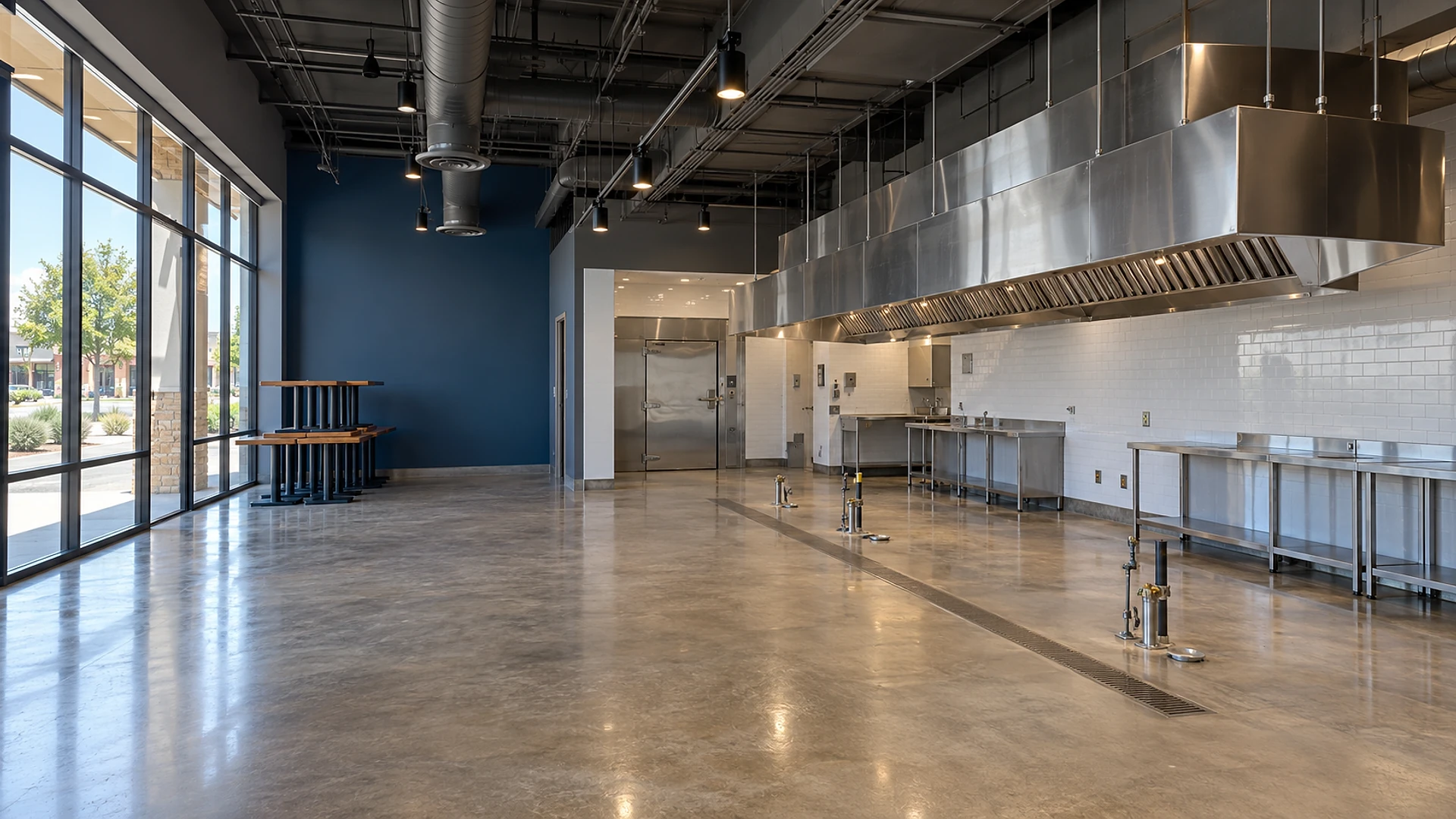
Taking over a former restaurant space can cut your build-out cost and time, but only for the parts that still work for your menu, your seat count and today's code. The kitchen hood, grease interceptor, restrooms and permits are where the savings usually disappear — so test them before you sign the lease, not after.
Restaurant owners across Texas love a "second-generation" space: a space that was already built out for a restaurant by an earlier tenant. The listing promises a hood, a walk-in cooler and drains already in the floor. Sometimes that's a real head start. Other times the equipment was sized for a different menu, the old approvals don't carry over, and the "turnkey" space ends up costing close to what an empty shell would have.
We see both outcomes in our tenant improvement work. The difference is almost never luck. It's whether someone checked the right 8 things during the lease negotiation, while the owner still had room to walk away or ask the landlord to fix them.
Key takeaways
- A former restaurant saves money only on items that still fit your menu and still pass inspection.
- Permits don't carry over. Your business needs its own health permit, and most cities review the build-out again.
- The hood, fire system and grease interceptor are the 3 items most likely to need testing, changes or replacement.
- Old restrooms aren't automatically "grandfathered." Once you remodel, accessibility rules come back into play.
- Test before you sign. Once the lease is signed "as is," every surprise is yours to pay for.
Is a former restaurant space really cheaper?
Often, yes — but by less than the listing suggests. The walls, floor drains, plumbing lines and sometimes the walk-in cooler can be reused, and those are real savings. What can't be assumed is that the expensive systems fit your operation. A coffee shop moving into an old pizza place needs very different cooking equipment, and a grill moving into an old bakery needs a very different hood.
The way to think about it: you're not buying a finished restaurant. You're buying a set of parts, some useful and some not, and the value is only in the parts you keep.
| Item | The listingSecond-gen space | On a walkthroughWhat to check |
|---|---|---|
| Kitchen hood | Hood in place, ready to cook. | Sized for the last menu; needs testing and a new fire system inspection. |
| Grease interceptor | Grease trap already installed. | May be too small for your cooking, or failing; needs a pump-out and inspection. |
| Restrooms | 2 restrooms, existing. | Often not wide enough for wheelchair access under current rules. |
| Permits | Previously a restaurant. | Your own health permit and usually a new build-out review. |
| Rent | Below new-construction rent. | Often signed "as is," with a smaller landlord allowance. |
None of these are reasons to avoid a second-generation space. They're reasons to price it honestly, so you can compare it fairly against an empty shell down the street.
Which myths cost restaurant owners the most?
Here are the 8 beliefs we hear most often from owners looking at former restaurant spaces, and what's usually true instead. Swipe through the cards; the sections below go deeper on the ones with the biggest price tags.
- 01
Myth: The kitchen is ready
Fact: It's ready for the last menu. A fryer-and-griddle hood may not cover a charcoal grill or a bigger cooking line.
- 02
Myth: Same use, no permits
Fact: Most Texas cities review a restaurant build-out again, and many issue a new certificate of occupancy for a new business.
- 03
Myth: The health permit transfers
Fact: Food permits in Texas belong to the operator, not the space. You apply for your own.
- 04
Myth: The grease trap passed before
Fact: A past pass says nothing about today. It may be undersized for your menu or cracked underneath.
- 05
Myth: Old restrooms are grandfathered
Fact: When you remodel, part of the budget usually has to go to access for people with disabilities.
- 06
Myth: The landlord allowance covers it
Fact: Second-gen spaces are often leased "as is," with little or no money for build-out.
- 07
Myth: We'll open in a few weeks
Fact: Even a mostly reused kitchen usually takes 4–8 months from lease to opening.
- 08
Myth: More seats is free money
Fact: Adding seats can trigger fire sprinklers, more restrooms and more parking.
Can you reuse the old hood and grease interceptor?
Sometimes. These are the 2 most valuable parts of a former restaurant, and the 2 most likely to cause trouble.
The hood and its fire system
A commercial kitchen hood is the stainless canopy over the cooking line that pulls smoke, heat and grease out through a duct to a fan on the roof. Under it sits a fire suppression system — nozzles that spray a fire-stopping chemical onto the cooking equipment if a fire starts. NFPA 96, the national fire standard for commercial kitchen ventilation that fire marshals use, covers how these hoods, ducts and fire systems are built, cleaned and maintained.
The problem is fit. A hood is sized to the equipment under it. Swap a short fryer line for a long charbroiler, or add a wok station, and the hood may be too short, the fan too weak, or the fire nozzles aimed at equipment that isn't there anymore. Moving nozzles is fairly cheap. A longer hood, a bigger fan or new duct through the roof is not.
Ask the landlord for the last hood cleaning and fire system service reports. Fire systems like these are usually serviced every 6 months. A space with no recent records has been sitting, and you should budget as if the system needs a full check and recharge.
The grease interceptor
A grease interceptor, often called a grease trap, is a tank — sometimes under the kitchen floor, often buried outside — that catches fats, oils and grease before they reach the city sewer. Grease clogs sewer lines, which is why the EPA's national pretreatment program pushes cities to control it, and why local utilities in Texas set their own sizing, pump-out and inspection rules.
2 things go wrong. First, the tank may be too small for your menu — a fryer-heavy operation produces far more grease than a sandwich shop. Second, older tanks crack and leak underground where nobody sees them. Replacing a buried interceptor means cutting pavement or the slab, digging, and patching, and it's one of the costs that most often turns a "cheap" space expensive. Ask for a pump-out and a camera inspection of the line before you sign.
Do you need new permits if it was already a restaurant?
Yes. This is the myth that costs the most time. The permits and approvals the last tenant held belonged to them, not to the space.
Your own health permit
In Texas, food businesses are permitted by the local health department where there is one, and by the state everywhere else. The state's retail food establishment program sets the baseline rules, and a food permit can't be handed from 1 operator to the next. Many local health departments also review your kitchen plans before construction — the number of sinks, the finishes, where food is stored and prepared — even when the kitchen already exists.
Building permit and certificate of occupancy
If you change walls, plumbing, electrical, the hood or the seating, you'll need a building permit. Many Texas cities also require a new certificate of occupancy — the city's approval to use the space — for a new business, even in the same use. The fire marshal will want to see the hood, the fire system and the exits work for your layout.
Seats matter more than owners expect. Under the International Building Code that most Texas cities use, a restaurant generally needs fire sprinklers once it holds 100 or more people or its fire area passes 5,000 square feet. An old space that squeaked under that line with 90 seats may pass it the day you add 20 more.
“The last tenant's permits
left with the last tenant.”
Restrooms and access for people with disabilities
"Grandfathered" is a word owners use a lot, and it's mostly wrong here. When you remodel a public space, the 2010 ADA Standards for Accessible Design and the Texas Accessibility Standards come into play. Under federal rules, when you alter the main areas of a space, you generally have to spend up to 20% of that work on an accessible route to it — the entry, the path, and the restrooms and drinking fountains that serve it.
In Texas there's a second step. A project with a construction cost of $50,000 or more has to be registered with the state and gets its own accessibility plan review and inspection. Our guide to TDLR accessibility review walks through when that's triggered. For a restaurant, this most often means rebuilding narrow restrooms — which is why "Restroom layout" sits in the dark boxes on the plan above.
What does it actually cost to take over a restaurant space?
It depends almost entirely on how much of the old kitchen fits your plan. Here's how build-out costs typically compare in Texas. These are planning ranges per square foot for the tenant's work, not a quote, and they don't include your cooking equipment, furniture or opening inventory.
The middle range is where most second-generation deals land. The hood is kept but extended or re-piped, the interceptor is replaced or upsized, the restrooms are rebuilt, and the dining room gets new finishes. That's still a real saving over an empty shell — it just isn't the "move-in ready" number owners hope for.
The same principle drives medical build-outs, where hidden systems cost more than finishes. Our breakdown of why medical office build-outs cost more shows the pattern in a different kind of space.
Where the landlord comes in
In a new shell, landlords often offer a tenant improvement allowance — money toward your build-out, paid back through rent. In a second-generation space, many landlords offer little or nothing, because they see the old kitchen as the allowance. That makes your walkthrough findings valuable. A failing interceptor or a non-working hood is a strong reason to ask the landlord to fix it before handover, lower the rent, or add an allowance.
How long does it take to open in a former restaurant space?
Faster than an empty shell, but rarely "a few weeks." For a space where the kitchen is mostly reused, plan on roughly 4–8 months from signing the letter of intent to opening day. Where the hood, interceptor or restrooms need real work, the longer end is more likely.
- 012–4 weeks
Test the space
Hood, fire system, grease line, power, gas and restrooms checked before you sign
- 024–8 weeks
Design
Floor plan, kitchen layout, and our structural, mechanical, electrical and plumbing engineering
- 034–10 weeks
Permits and health review
City building review, fire marshal and health department plan review
- 046–12 weeks
Construction
Kitchen changes, restrooms, finishes and equipment hookups
- 052–4 weeks
Inspections and opening
Health, fire and building inspections, then the certificate of occupancy
Planning ranges, not a project quote. Timing varies with owner decisions, project complexity, and jurisdiction workload.
The permit stage is the one owners can't speed up by working harder. What helps is submitting a complete set the first time, with the kitchen layout, equipment list and hood details that health and fire reviewers ask for. Incomplete submittals are the most common reason a restaurant opening slips by a month or more.
It's also why we keep architecture and engineering together. The hood, the gas line, the electrical panel and the plumbing all touch each other in a restaurant kitchen, and when they're drawn by one team under 1 agreement — the way we describe in 1 contract, not 4 — the pieces fit before the reviewers ever see them.
What should you check before signing a restaurant lease?
The best time to find a problem is before the lease is signed, while you can still negotiate. Many landlords will agree to a short testing period, or will let you make the lease depend on the results. For bigger decisions, our feasibility and due diligence service puts all of this in 1 short report with rough costs attached.
- Hood length and fan size vs your cooking line
- Fire system service reports from the last 12 months
- Grease interceptor size, pump-out records and a camera check of the line
- Electric panel size vs your equipment list
- Gas service size, if you cook with gas
- Restroom width, door clearances and grab bars for access
- Number of seats you need vs the sprinkler and restroom lines
- Condition of the roof around the hood fan
- Health department history for the address, where public
- Lease terms: "as is" clause, allowance and who fixes what
Bring the equipment list for your menu to the walkthrough. Every check above is really the same question: does what's here work for what you'll cook, the way you'll serve it, with the number of people you want to seat?
You can see how we approach restaurants, hotels and event spaces on our hospitality sector page.
Frequently asked questions
It's a space that was already built out and used as a restaurant by an earlier tenant. It usually still has a kitchen hood, floor drains, a grease interceptor and restrooms. How much of that you can reuse depends on your menu, your layout and the condition of each item.
Usually, but by less than owners expect. Reusing walls, drains and plumbing saves money, while the hood, grease interceptor and restrooms often need changes. As a planning range, a reworked second-generation space often runs about half the cost per square foot of building a restaurant from an empty shell.
No. Food permits in Texas belong to the business operating the kitchen, not to the space. A new operator applies for their own permit, and many local health departments review the kitchen plans before construction or opening.
If you change anything beyond light cleaning and painting — walls, plumbing, electrical, the hood or the seating — you almost certainly do. Many cities also require a new certificate of occupancy for a new business. Check with the city before you sign so the timeline is built into your lease.
Often, if your cooking equipment fits under it and the fan and fire system are sized for it. A different menu can mean a longer hood, a stronger fan or new fire nozzles. Ask for recent service reports and have the hood checked against your equipment list.
Your local utility or plumbing code sets the required size based on the kitchen's fixtures and flow. Get the tank's size and pump-out records, then compare it with what your menu and sinks need. A camera inspection of the line can reveal cracks and blockages you can't see.
Not once you remodel. When you alter the main areas of a space, federal rules generally require spending up to 20% of that work on an accessible route, including restrooms. In Texas, projects of $50,000 or more also get a state accessibility review and inspection.
Plan on roughly 4–8 months from signing to opening when much of the kitchen is reused. Permits and health review are usually the longest stretch you can't control. Submitting complete drawings the first time is the best way to stay on schedule.
An architect with in-house engineering can check the hood, grease line, power, gas and restrooms against your menu and seat count in 1 visit. Doing it before signing gives you facts to negotiate with, instead of surprises to pay for.
Looking at a former restaurant space?
If you're weighing a former restaurant space anywhere in Texas, send us the address, your menu and the number of seats you're aiming for through our contact page. We'll tell you which parts of the old kitchen are likely worth keeping, what needs testing before you sign, and what to ask the landlord for.
