
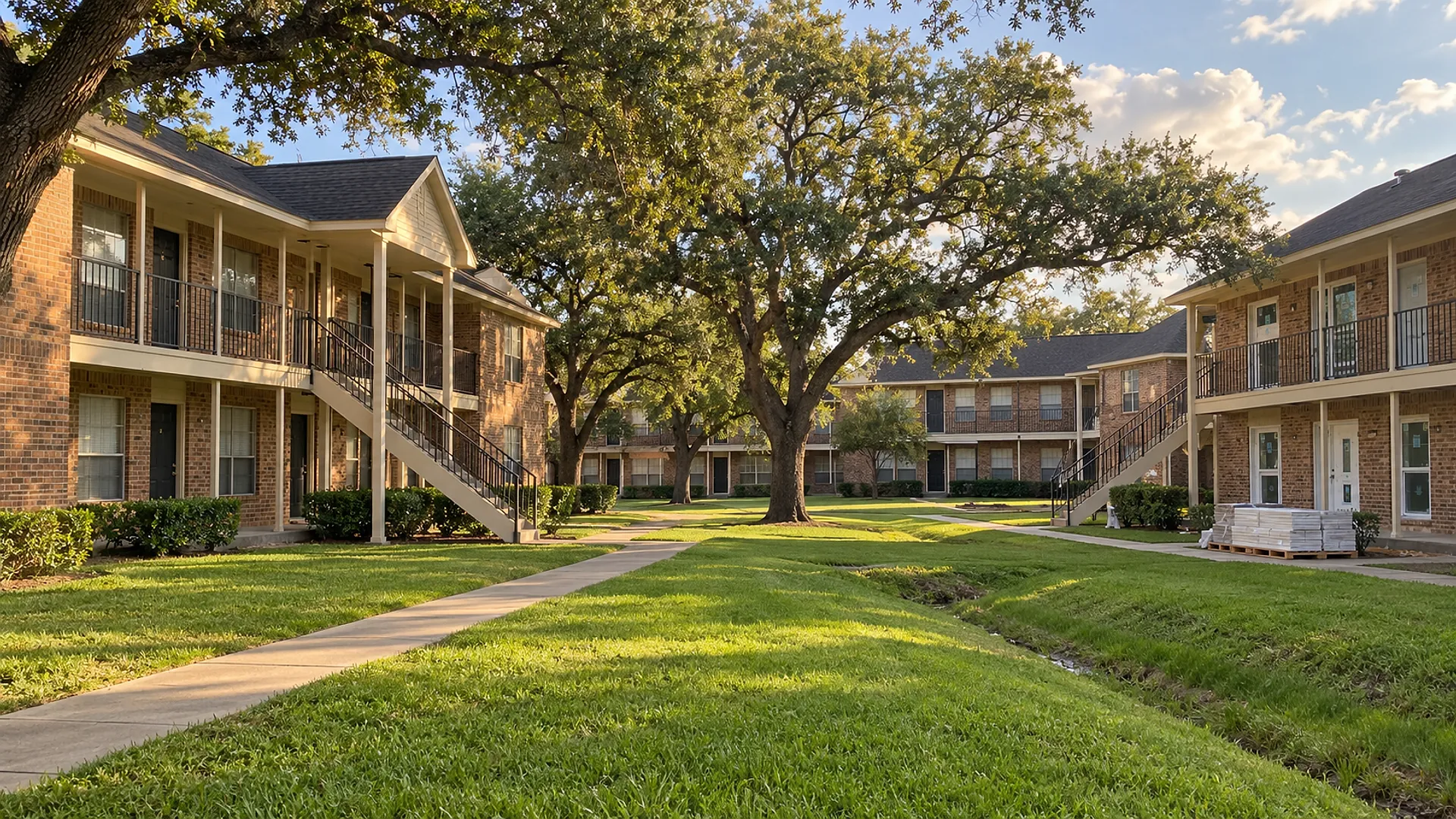
In the City of Houston, if renovating an apartment building in the 100-year floodplain costs 50% or more of the building's market value, the building has to meet today's flood rules as if it were new. For apartments, that means the lowest floor and all its equipment must sit at least 2 feet above the 500-year flood level. On most older complexes that's impossible without losing the ground-floor units, so the 50% line quietly sets the ceiling on your renovation budget.
This matters most to a buyer. A value-add purchase of a 1970s or 1980s complex usually comes with a plan to spend real money on the buildings: new kitchens, baths, air conditioning, plumbing, windows, roofs. Put that complex in the floodplain and the plan has to be tested against the 50% line before you close, not after the permit application comes back. This article walks through that test, the way we run it in our feasibility and due diligence service. The numbers below are planning ranges, not a quote.
Key takeaways
- The rule counts the value of the building only, never the land, and never what you paid for the whole property.
- The city accepts the appraisal district's building value, a certified appraiser's value, or FEMA's damage method — a better value can raise your ceiling.
- Almost all building work counts toward the 50%, including the contractor's overhead and profit. Site work like paving and landscaping usually doesn't.
- Repairing flood damage counts too. A complex that flooded badly may already be over the line.
- Splitting 1 renovation into several small permits doesn't get around the rule.
- Check the flood map, the building value and the ground-floor height before your option period ends.
- The trigger
- 50% of building value
- Land value
- Not counted
- Required floor
- 500-year flood + 2 ft
- In force since
- September 2018
What is Houston's 50% rule for floodplain renovations?
Houston's floodplain law is Chapter 19 of the City Code. It calls a renovation a "substantial improvement" when its cost equals or exceeds 50% of the market value of the structure before work starts. The same term covers "substantial damage": damage of any cause that would cost 50% or more of the building's value to repair.
The idea comes from the national flood insurance program: older buildings may stay as they are, but when an owner spends enough to make one effectively new, it should be made safe from flooding at the same time.
What "meeting the rules" means for apartments
Since September 2018, Houston has asked for more than the federal minimum. In the 100-year floodplain (zones marked A or AE on the flood map), a substantially improved residential building must have its lowest floor and all its utilities at or above the 500-year flood level plus 2 feet. The city calls that the minimum flood protection elevation. We'll call it the required floor level.
Apartments count as residential. An office or shop building in the same spot could instead be sealed against water up to that level, which is called floodproofing, but a building where people sleep can't use that route. The living space has to be above the line.
What about the 500-year floodplain?
The rule is at its strictest in the 100-year floodplain. In the area that floods only in a 500-year storm (shaded zone X on the map), the elevation rule as written applies to new buildings and additions. And a building in the floodway, the channel and the land right beside it that carry fast-moving water, generally can't be substantially improved at all. Your exact zone decides which of these applies, so it's the first thing we check.
Most older garden apartments in Houston sit on a concrete slab poured a step or 2 above the lawn. The required floor level is often 1–4 feet higher than that slab. You can't raise a 2-story brick building on a slab the way you can lift a small wood house, so going over 50% usually means giving up the ground-floor apartments or rebuilding.
Which building value does the city use?
This is where most buyers get the math wrong. They take the purchase price, divide by 2 and call that the renovation budget. But the rule measures the structure only, with the land taken out.
Chapter 19 accepts 4 ways to set that value:
- The building value (called the improvement value) from the county appraisal district. In Harris County, that's HCAD. It's free and quick, but on older complexes it's often low.
- FEMA's damage estimating method, mostly used after a flood.
- An appraisal by a certified appraiser licensed in Texas, valuing the building before the work.
- Another method the city engineer accepts.
On an older complex, an appraiser who values the buildings alone often lands higher than the appraisal district, because the district's number is built for taxes, not for this test. A higher value raises your 50% ceiling. That appraisal costs a few thousand dollars and can be worth hundreds of thousands in budget room, so we ask for it early on any complex that's close to the line.
It's measured building by building
The rule talks about "a structure." On a complex with 12 separate buildings, expect each building to be looked at on its own, and only the buildings inside the mapped floodplain to be tested at all. So a buyer can often spend freely on buildings on high ground and hold back on the 2 or 3 that sit low. It also means a single value for the whole property from the appraisal district has to be split across the buildings, and how it's split should be agreed with the city's floodplain office, not assumed.
Drag the slider to see where the line falls for 1 building:
- Renovation cost that reaches the line$1,000,000Measured on the building work, including overhead and profit
- Budget with a safety cushion$800,000–$900,000Leaves room for surprises found behind walls and ceilings
Planning math only. The city decides which value counts and which costs are in.
Planning ranges, not a project quote. Cost and timing vary with owner decisions, project complexity, market conditions, and jurisdiction workload.
What counts toward the 50%?
Almost everything done to the building. FEMA's Substantial Improvement/Substantial Damage Desk Reference, the guide local floodplain offices work from, lists what's in and what's out.
In the count
Materials and labor, including owner-supplied materials and your own staff's labor. Demolition. Structure, walls, windows, doors and roofing. Floors, drywall, paint, cabinets and bathroom fixtures. Air conditioning and heating, plumbing, wiring and lights. Built-in appliances. Work that another code forces on you because of the renovation, such as accessibility upgrades. And the contractor's overhead and profit, plus sales tax on materials.
Out of the count
Design drawings, surveys, permit and inspection fees. Plug-in appliances like washers, dryers and stoves. Carpet laid over an existing finished floor. Work outside the building: paving, landscaping, fences, sidewalks, the pool and detached buildings like a carport or a maintenance shed. And the minimum work needed to fix health and safety violations that a city inspector has already cited in writing.
So parking lot repaving, site lighting, a new pool deck and fences can all go ahead without eating into any building's 50%.
Here is roughly what different levels of renovation cost per apartment on an older Houston complex, next to what the building itself is often worth per apartment. "AC" is the air conditioning and heating system:
The overlap is the whole story. A light refresh almost never reaches the line. A heavy rehab of a building worth $40,000–$50,000 per apartment very often does.
Should you stay under 50% or go over?
Once you know where the line is for each building, there are 2 honest paths.
Stay under. Scope the work so each floodplain building stays below 50%, with a cushion. You keep every apartment. The building stays as flood-prone as it was, so flood insurance and the risk of a future flood stay the same. And you can't come back next year with the rest of the plan: FEMA's guide tells local officials to watch for 1 renovation split into several permits over time, and the city can ask you to confirm in writing that the application covers all the work you plan.
Go over. Do the full renovation and bring the building up to the required floor level. On a slab-on-grade building, that usually means turning the ground floor into parking, storage or building entry, with flood vents that let water pass through, and keeping apartments only above the line. Some owners add a floor on top to win units back, which brings its own structural and fire-code questions.
| Question | Stay under 50% | Go over 50% |
|---|---|---|
| Ground-floor apartments | Stay as they are | Must move above the required floor level |
| Scope of work | Limited by the 50% ceiling | Whatever the plan needs |
| Flood risk after | Same as today | Much lower for living space |
| Flood insurance | Stays tied to the old floor height | Usually improves with a raised floor |
| Rent roll | Unchanged unit count | Fewer units unless you add a floor |
| Paperwork | Cost estimate the city accepts | Elevation certificate and full floodplain permit |
Sometimes the right answer is neither. If a low building has flooded more than once, demolishing it and rebuilding the units on higher ground elsewhere on the property can beat both paths. That's a design question as much as a budget one, and it's why we like to see the whole site plan before a buyer commits to a number.
“The purchase price isn't the number.
The building's value is.”
What if the complex has already flooded?
Then the test may already have been run for you. If flood damage to a building would cost 50% or more of its pre-flood value to repair, the building is "substantially damaged," and repairing it brings the same elevation rule, no matter what the repair includes. After major storms, cities often make these calls building by building and send letters to owners.
For a buyer, that means 3 things to find in the seller's records: any letter from the city about substantial damage, the permits pulled for past flood repairs, and the insurance claims history. If a building was already found substantially damaged and wasn't brought up to the rules, you want to know before closing, not at your first permit application.
What should you check before your option period ends?
The test is quick if it's done in the right order. Start with the map: FEMA's Flood Map Service Center shows the current zone for every building. Then look ahead: the Harris County Flood Control District's MAAPnext project is redrawing the county's flood maps, and its draft maps can show a building moving into, or out of, the floodplain. Our guide to industrial land checks around Houston covers the same maps from a land buyer's side.
Next, get the real floor heights. A surveyor's elevation certificate records the height of each ground floor against the flood levels. With that and the building values, you can test your renovation plan building by building.
- Flood zone for each building, current and draft maps
- Is any building in the floodway?
- Ground-floor heights from an elevation certificate
- Building value from the appraisal district, split by building
- A certified appraisal of the buildings, if it's close
- Renovation cost per building, sorted in and out of the count
- Seller's letters, permits and claims from past floods
- Which city office reviews the site, and its written position
Inside or outside the city limits?
Everything above is City of Houston law. A complex in unincorporated Harris County, Fort Bend County or a nearby city follows that government's floodplain rules, which share the 50% idea but differ in the required floor height and paperwork. The first step on any site is confirming whose rules apply.
How do we help a buyer test this?
We run this test during the option period, as part of the wider unit-count and site work described in our feasibility playbook for Texas apartment sites. Our architects and our structural and MEP engineering are one team, so the renovation scope, the cost split and the ground-floor options come from the same people. Where the answer depends on the city's view, we ask the floodplain office before you close.
After closing, our owner's representation service keeps the renovation inside the line you planned, checking every change order against each building's ceiling. More on the property type is on our multifamily sector page.
Frequently asked questions
If the cost to renovate or repair an apartment building in the City of Houston's floodplain equals or exceeds 50% of the building's market value, land not counted, the building must meet current flood rules. For residential buildings in the 100-year floodplain, that means the lowest floor and utilities at least 2 feet above the 500-year flood level.
No. It uses the market value of the building alone, before the work, with land value left out. The purchase price of a whole complex includes land and income value, so it's almost always higher than the number the city uses.
Yes. Houston accepts a building value from the county appraisal district, from FEMA's damage method, or from a certified appraiser licensed in Texas, among other methods the city engineer accepts. A separate appraisal of the buildings is often higher than the tax value on older properties.
Generally not. FEMA's guidance leaves out work outside the building, such as paving, landscaping, fences, sidewalks, pools and detached structures, along with design fees, surveys and permit fees. Work on the building itself, including the contractor's overhead and profit, counts.
No. FEMA's guidance tells floodplain offices to look at all the planned work, not permit by permit, and the city can ask for a written statement that the application covers all the work. Planning a real, limited scope is fine; hiding the rest of the plan isn't.
The rule applies to a structure, so expect each building to be tested on its own, and only buildings inside the mapped floodplain to be tested. Confirm with the floodplain office how a single property value should be split across the buildings.
It has to be brought up to current flood rules when it's repaired, which for apartments means raising living space above the required floor level. Owners usually get a letter from the city after a major storm. Buyers should ask the seller for any such letter.
Not the living space. Sealing a building against water is an option for offices, shops and warehouses, but residential buildings must have their lowest floor above the required level. Ground floors can be used for parking, storage or building entry with flood vents.
Usually 2–4 weeks: a few days for maps and appraisal district values, 1–2 weeks for an elevation survey, and more if a separate appraisal or a meeting with the floodplain office is needed. Start it in the first week of your option period.
Buying an older complex in the floodplain?
If you're under contract on an older apartment complex, or about to be, test the 50% line before your option period ends. Send us the address, the rent roll and the renovation plan, and we'll tell you which buildings can take the full plan, which can't, and what your choices are. Start a conversation with us.
