
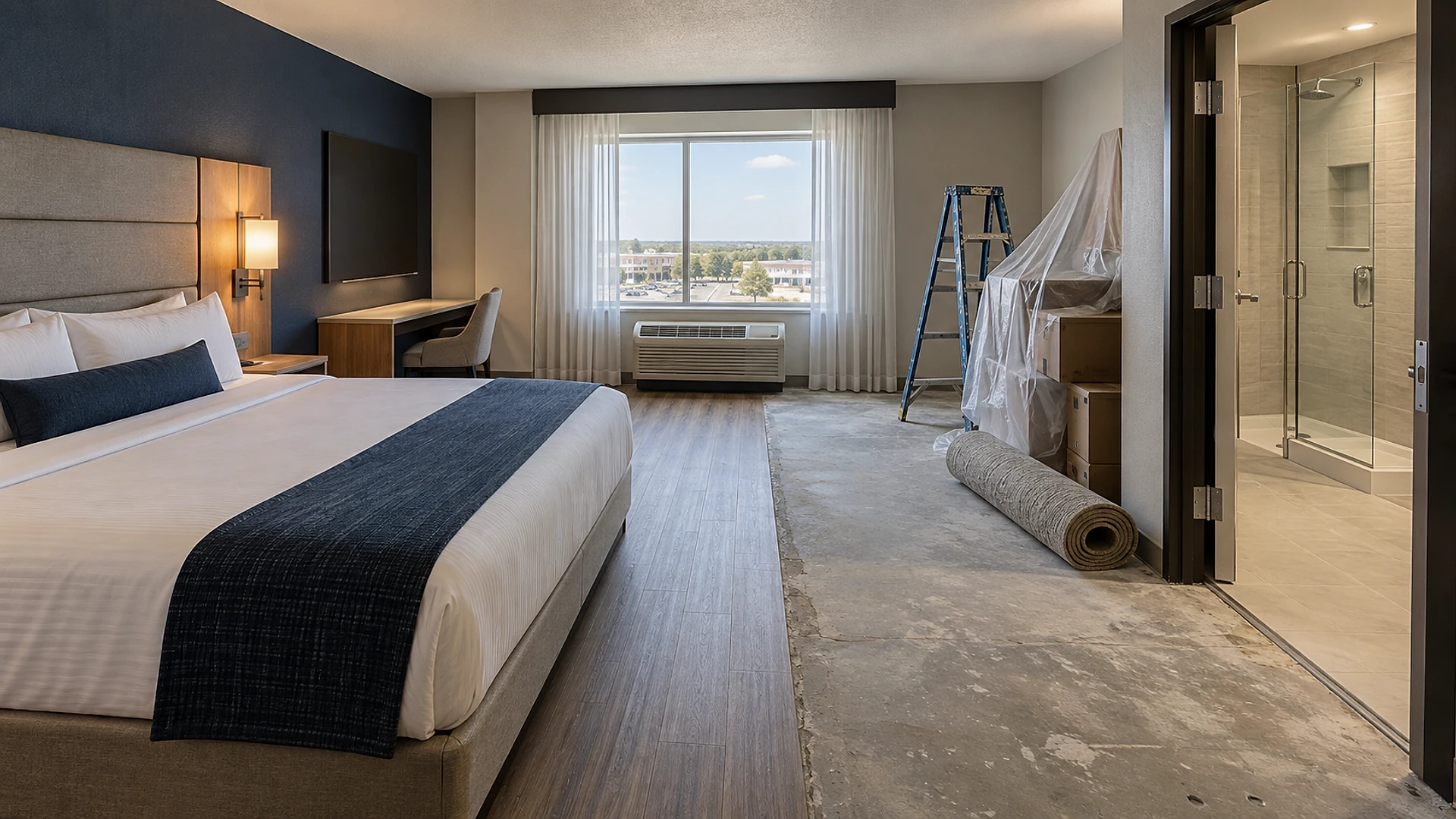
A hotel PIP (property improvement plan) is the brand's list of upgrades an owner must finish by a set date, and it is never the whole project. The moment you renovate guest rooms in Texas, building permits, state accessibility review and the federal rules for accessible rooms come along with the work, and none of that is on the brand's list. Owners who budget only from the PIP tend to run 15–30% over and months late.
You usually get a PIP in 2 moments: when you buy a branded hotel, and when your franchise agreement comes up for renewal. Sometimes the brand also issues one mid-term, when it rolls out a new room design across the chain. Either way, a document of 20–60 pages lands on your desk with a deadline, and the clock starts. We see the same 6 beliefs cost owners money again and again. Below, each one is set against what actually happens on a Texas project, the way we test it in our owner's representation service. All numbers are planning ranges, not a quote.
Key takeaways
- The PIP lists brand items only. Code work that the renovation sets off, like accessible rooms, fire alarm devices and permits, is extra.
- In Texas, a renovation with an estimated cost of $50,000 or more must be registered with the state for accessibility review.
- Altered guest rooms must include accessible rooms until the hotel has the number a new hotel of its size would need.
- Cost per room swings widely with bathrooms, room mix and the building's age, so last year's number from another hotel is a poor guide.
- Furniture lead times of 12–24 weeks often set the schedule more than construction does.
- Read, price and negotiate the PIP before you close on a hotel, not after.
What is a hotel PIP, and when do you get one?
A PIP is a written list from the hotel brand, the company whose name is on the sign, of everything the property must upgrade to stay in (or join) the brand. It's tied to your franchise agreement, so missing the deadline can bring penalties or, in the worst case, loss of the brand.
A typical PIP is organized by area: guest rooms, guest bathrooms, corridors, lobby and breakfast area, pool and fitness room, exterior and parking lot. Each line names an item and a standard, such as "replace carpet with approved vinyl plank" or "convert 50% of tubs to walk-in showers." Most PIPs also refer to the brand's design standards, a separate and much longer book.
Why the timing matters
If you're buying, the seller's PIP is really your PIP. The brand issues it to the buyer as a condition of transferring the franchise, and the cost comes out of your pocket after closing. That makes the PIP a price question, not just a construction question. We cover how hotel projects are sized and approved from the ground up in our plain-English hotel glossary; this article is about the buildings that already exist.
Is the PIP the whole scope of work?
It isn't. The brand writes the PIP to protect its guest experience. It doesn't check what your city's building code, the state's accessibility rules or the federal accessibility standards will require once the work starts. Those are your responsibility, and they don't care what the brand asked for.
Here's how the 3 lists stack up on a typical guest-room renovation:
The brand asks
New carpet or vinyl plank
New beds, desks, lighting
Tub-to-shower conversions
The city asks
Permits for plumbing, electrical and wall AC units
Fire alarm devices kept working
Inspections floor by floor
The state and federal rules ask
Accessible rooms in the altered count
Accessible route to what you renovate
State registration at $50,000 and up
In practice, the brand's list is the starting point. Our job is to turn it into a full scope that includes the code items, before anyone prices anything. A contractor's bid built only from the PIP will be missing those items, and they come back later as change orders, which are extra charges added after the contract is signed.
Does "only furniture and carpet" really skip permits?
Swapping a bedspread doesn't need a permit. But very few PIPs stop at bedspreads. Replacing a tub with a walk-in shower is plumbing work. New wall-mounted air conditioning units (the through-wall units under the window, called PTACs) usually mean electrical and mechanical permits. Moving lights, outlets or a TV wall means electrical work. Changing the room's entry door or its hardware touches a fire-rated door, which has its own rules.
Then there's the state. Under the Texas Architectural Barriers Act, a privately funded building open to the public, which includes every hotel, must be registered with the Texas Department of Licensing and Regulation (TDLR) when the estimated construction cost is $50,000 or more. The plans get an accessibility review before construction and an inspection after. TDLR's architectural barriers FAQ spells out the $50,000 threshold. We explain the whole process in our article on TDLR accessibility review. Almost any PIP clears $50,000 by the second floor.
If the item is fastened to the building, carries water or power, or changes how someone gets in, out or around the room, assume it needs design and a permit. If you can carry it out the door, it probably doesn't.
What a permit set looks like for a PIP
It's lighter than a new building. We draw the typical rooms, the accessible rooms, the bathroom changes, the lighting and power changes and any work in the corridors or public areas. Our structural and MEP engineering (mechanical, electrical and plumbing) is part of the same team, so the drawings for the wall AC units, the lighting and the plumbing come from 1 set instead of 3 separate offices.
Are your old accessible rooms grandfathered?
This is the belief that surprises owners most. The 2010 ADA Standards say it directly in section 224.1.1: when guest rooms are altered, the accessible room rules apply to the rooms being altered until the hotel has the number of accessible rooms a new hotel of its size would need. You can read it in the 2010 ADA Standards for Accessible Design.
For many older hotels, the original accessible rooms were built under older rules, or some were quietly turned into standard rooms over the years. A renovation is when that gap gets found and fixed. The standards also want accessible rooms spread across room types (king, 2 queens, suite), not all bunched on the ground floor.
Here's what the table asks for a hotel with 101–150 rooms:
| Requirement | What it means | For this hotel |
|---|---|---|
| Rooms with mobility features | Wider doors, clear floor space, grab rails, reachable controls | 7 rooms |
| Of those, with roll-in showers | A shower with no curb that a wheelchair rolls into | 2 of the 7 |
| Rooms with communication features | Visual alarms and notification for guests who are deaf or hard of hearing | 12 rooms |
| Spread across room types | Not all in 1 room type or 1 floor | Kings, 2-queen rooms and suites |
And the path to those rooms
Federal rules also cover the route. When you alter an area people use for the building's main purpose, like guest rooms, the regulation in 28 CFR 36.403 says the accessible path to that area, and the restrooms and drinking fountains that serve it, must be made accessible too, up to a cost of 20% of the alteration. The U.S. Access Board's guide to alterations explains how that 20% works. In a hotel, that path runs from the parking lot and drop-off, through the lobby, to the elevator and down the corridor.
Will last hotel's cost per room work here?
Cost per room (the industry says "per key") is a useful yardstick, but only between similar hotels. The biggest swing is bathrooms. A room where you replace the vanity top and the lighting costs a fraction of a room where you tear out the tub, waterproof the floor and tile a new walk-in shower. Room mix, the age of the plumbing, how many accessible rooms must be added and what the public areas need all move the number.
Drag the room count to see how the planning ranges move:
- Light refresh (fabrics, carpet, paint, lighting)$800,000–$1,500,000About $8,000–15,000 per room
- Full room renovation (furniture and bathrooms)$2,200,000–$4,000,000About $22,000–40,000 per room
- Lobby, pool, exterior and parking, added on$300,000–$1,000,000Spread across the rooms, about $3,000–10,000 each
- Construction, rooms taken out floor by floor16–27 weeks
Planning ranges only. The PIP, the building's age and the code items decide the real number.
Planning ranges, not a project quote. Cost and timing vary with owner decisions, project complexity, market conditions, and jurisdiction workload.
Where the money goes on a full room renovation looks roughly like this:
The number that moves the most
It's the bathroom line. That's why we price 2 versions of it early: the brand's preferred full conversion, and a lighter option that still meets the standard. Brands often accept a phased approach for bathrooms if you ask with a clear plan, and that alone can shift the budget by 20–30%.
Should you start building now to hit the deadline?
The deadline is real, but starting construction first is the slowest way to meet it. Before a crew touches a room, the design has to go to the brand for approval, the permit set has to go through city review, the state accessibility registration has to be filed, and, most importantly, the furniture has to be ordered. Hotel furniture, fixtures and equipment (FF&E) is usually made to order, and lead times of 12–24 weeks are common.
“The contractor isn't the critical path.
The furniture order is.”
Most hotels renovate while open, taking 1 or 2 floors out of service at a time. That keeps revenue coming in, but it means the first floor can't start until its furniture arrives, and every floor after it needs the next delivery on time. Here's a typical sequence for a 100–150 room hotel:
- 012–4 weeks
Scope, code check and budget
PIP turned into a full scope with the code items priced
- 026–10 weeks
Design and brand approval
Model room design, finishes, accessible room layout
- 034–10 weeks
City permit and state registration
Runs while furniture is ordered
- 046–12 weeks
Furniture and fixture delivery
What's left of the lead time after approval
- 0512–30 weeks
Construction, floor by floor
1–2 floors at a time while the hotel stays open
Planning ranges, not a project quote. Timing varies with owner decisions, project complexity, and jurisdiction workload.
Ask for time early
If the math doesn't fit the deadline, ask the brand for an extension before you start, with a schedule that shows why. Brands deal with this constantly. An extension request backed by real lead times gets a much better hearing than a missed deadline explained afterward.
Is an owner's rep just another layer of fees?
An owner's representative works for you, not for the brand and not for the contractor. On a PIP, that means turning the brand's list into a full scope, pricing the code items before bids go out, keeping the brand's approvals, the permits and the furniture orders moving at the same time, and checking every change order against the contract. We hold no construction contract, so our only interest is your budget and your deadline.
Owner's representation on a renovation like this typically runs a few percent of the project cost. The money it protects is usually larger: 1 missed code item priced late, 1 floor of furniture that arrives after the crew is ready, or 1 change order approved without review can each cost more than the fee. How architecture, engineering and owner-side management fit together is covered in our article on 1 contract instead of 4, and you can see an owner's rep work through a project from start to finish in our hypothetical mosque project walk-through.
Before you sign a purchase contract or a franchise renewal, this is the list we work through:
- Every PIP line priced, not just the big ones
- Code items the brand didn't list
- Accessible room count vs today's standard
- Accessible route from parking to the rooms
- State registration needed at $50,000 and up
- Bathroom scope: full conversion or lighter option
- Furniture lead times against the deadline
- Floors out of service and lost room nights
- Fire alarm and sprinkler work touched by the renovation
- Room for an extension request, in writing
If you're buying, the checklist feeds straight into the price. A PIP that turns out to need $1.5 million more than the seller assumed is a reason to negotiate, and it's much easier to raise before closing than after. It's the same logic we bring to any hotel project in our hospitality work.
Frequently asked questions
PIP stands for property improvement plan. It's the brand's written list of upgrades a hotel must complete, by a set date, to join or stay in the brand. It usually comes with a change of ownership or a franchise renewal.
It varies widely. A light refresh of fabrics, carpet, paint and lighting often lands around $8,000–15,000 per room, while a full renovation with new furniture and bathrooms commonly runs $22,000–40,000 per room, before public areas. These are planning ranges; the PIP and the building decide the real number.
Most do. Plumbing, electrical and wall AC unit work, bathroom conversions and changes to fire-rated doors or fire alarm devices need city permits. A project with an estimated cost of $50,000 or more must also be registered with TDLR for accessibility review and inspection.
Usually, yes. Under the 2010 ADA Standards, altered guest rooms must include accessible rooms until the hotel reaches the number required for a new hotel of its size, spread across room types. A 101–150 room hotel, for example, needs 7 rooms with mobility features, 2 of them with roll-in showers.
Yes, and most owners do. Work usually moves 1 or 2 floors at a time, with those rooms out of service. It keeps revenue coming in but makes the schedule depend on furniture arriving on time for each floor.
For a 100–150 room hotel, plan on roughly 7–15 months from receiving the PIP to the last renovated room. Design, brand approval, permits and furniture lead times take up a large share of that before construction starts.
Often, yes. Owners commonly negotiate deadlines, phasing and specific items, especially when they bring a clear scope, budget and schedule. The best time is before you buy or before you sign a renewal.
Yes. The brand issues the PIP to the buyer as a condition of transferring the franchise, so its cost is really part of your purchase price. Get it during due diligence, price it fully, and use the result in your negotiation.
They manage the project on the owner's side: turning the PIP into a complete scope, running bids, coordinating brand approvals, permits and furniture orders, and reviewing every change order and payment. They don't build anything and hold no construction contract.
Holding a PIP with a deadline on it?
Send us the PIP, the room count and the deadline, and tell us whether you're buying or renewing. We'll turn the brand's list into a full scope with the code items priced, show you where the schedule really runs, and tell you what to ask the brand for before you commit. Start a conversation with us.
