
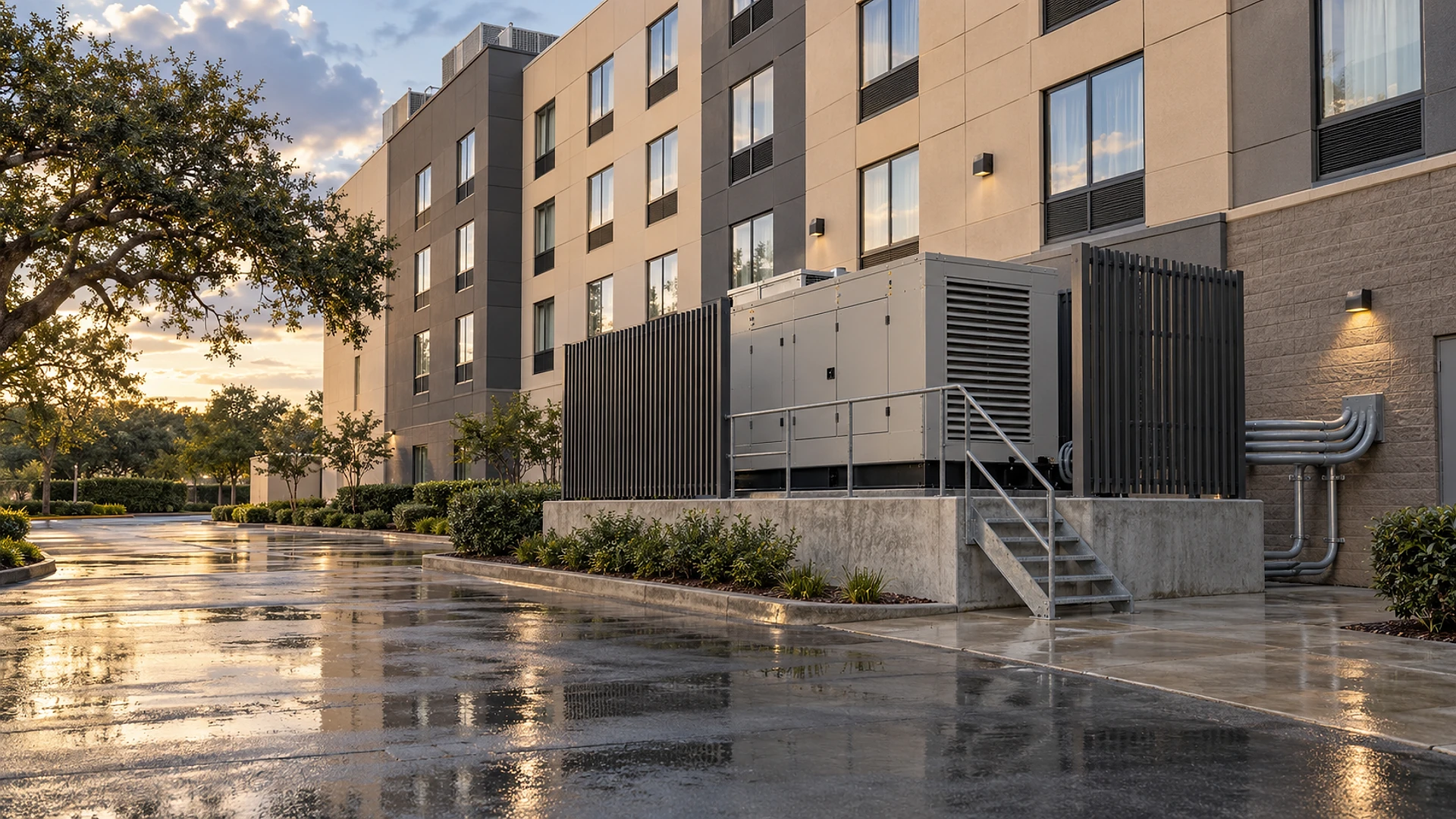
Adding a backup generator to a Houston hotel is usually an owner's choice, not a code requirement, unless the building is a high-rise. The work comes down to 4 decisions (what it powers, which fuel, where it sits and how it connects) and 3–4 city and state sign-offs, and most projects take 9–18 months from the first study to the day the generator carries the building.
In July 2024, Hurricane Beryl left more than 2 million homes and businesses in the Houston area without power, many of them for a week or longer. Hotels felt it twice. Guests checked out of dark, hot rooms, and the hotels that did have power filled up with utility crews, insurance adjusters and families who had fled their own homes. Since then, "Can we add a generator?" has become one of the first questions hotel owners ask us.
The answer is almost always yes, but a generator is a small building project in its own right. This article walks through it for a typical 4- to 6-story Houston hotel. It's planning guidance, not engineering for your building.
Key takeaways
- Most hotels under 75 feet don't need a generator by code. Batteries already run the exit signs and path lighting. A generator is a business decision about staying open.
- Start with the list of what must keep running. Lobby, 1 elevator, the fire alarm, water pumps and the network are the usual core. Guest-room cooling is the expensive part.
- Diesel and natural gas both work, with different weak points. Diesel runs out; gas depends on the gas line staying up.
- Put it high and dry. In Houston's regulated floodplain, the city expects commercial equipment at the 500-year flood level plus 2 feet.
- Order early. Larger generators can take 6–12 months to arrive, often longer than design and permits combined.
- Typical hotel generator size
- 150–1,000 kW
- Diesel fuel kept on site
- 24–72 hours
- Generator lead time
- 6–12 months
- Study to switch-on
- 9–18 months
Does a Houston hotel have to have a backup generator?
For most hotels, no. The building code requires emergency lighting along exit paths and lit exit signs, and in a typical 4- to 6-story hotel those run on batteries built into the fixtures for at least 90 minutes. The fire alarm has its own batteries too. None of that needs a generator.
The picture changes for a high-rise. In building-code terms, a high-rise is a building with an occupied floor more than 75 feet above the lowest level where fire trucks can park, which in practice means roughly 7 stories or more. High-rise hotels must have standby and emergency power for things like fire pumps, at least 1 elevator, smoke control and exit lighting, so if your hotel is that tall, the generator is already there and the question becomes whether to make it bigger.
The 3 kinds of backup power
The electrical code, NFPA 70 (the National Electrical Code), sorts backup power into 3 groups. Emergency systems keep people safe while they leave, and must come on within 10 seconds. Legally required standby systems serve things a code demands, such as a fire pump. Optional standby systems are everything else: power the owner chooses to have so the business keeps running. A generator added to a mid-rise hotel after a storm almost always falls in this third group.
That gives you the most freedom: you decide what it powers and how long it runs.
What should a hotel generator actually power?
This decision drives everything else, including the price. We start with a walk through the building, asking the owner and general manager: if the grid goes down for 5 days, what has to keep working for you to stay open and keep guests safe?
The answers fall into 3 tiers. The core is the lobby and front desk, the fire alarm, at least 1 elevator, the water pumps, the network, the walk-in cooler and some corridor lighting. The second tier adds the breakfast kitchen and laundry. The third, and by far the biggest, is guest-room cooling.
Why guest-room cooling changes the size so much
In a Houston July, air conditioning is what makes a room sellable. But every room has its own unit, and together they can draw more power than the rest of the hotel combined. Powering the core alone might take a 150–300 kW generator (kW, or kilowatts, measures how much power it can deliver at once). Adding cooling for every room can push the same hotel to 800 kW–1 MW.
Many owners split the difference: they power the core plus cooling on 1 or 2 guest floors. That gives the hotel 40–80 rooms it can sell during an outage, often at full rate, for a fraction of the whole-building price. Our engineering team measures the real loads and builds the design around the tier you choose.
The generator is the easy part to buy. The hard part is finding a spot on a built hotel site that is close to the electrical room, far from guest windows, reachable by a fuel truck and above the flood line, all at the same time.
Diesel or natural gas for a hotel generator?
Both are common in Houston, and neither is perfect. A diesel generator carries its fuel in a tank under the machine, usually enough for 24–72 hours. It starts fast and doesn't depend on any utility line. But after a big storm, every hospital and data center in the region is calling the same fuel suppliers for refills.
A natural gas generator draws from the gas line, so it runs as long as gas keeps flowing, and in most Houston storms the gas system stays up when power lines come down. The trade-offs: it usually costs more for the same output and may need a bigger gas meter, which can add weeks or months. A "bi-fuel" unit, which starts on diesel and blends in gas, sits in between.
| Question | Diesel | Natural gas |
|---|---|---|
| Where the fuel comes from | A tank under the generator | The gas utility's line |
| How long it runs | 24–72 hours, then a fuel delivery | As long as gas keeps flowing |
| Cost for the same size | Usually lower | Usually 10–30% higher |
| Extra approvals | Fire marshal review of the fuel tank | Gas meter and service upgrade from the utility |
| Biggest risk after a storm | Fuel trucks booked solid | Rare gas outages or low pressure |
| Upkeep | Fuel testing and tank care | Fewer fuel chores, regular test runs |
Where can a generator go on a hotel site?
On a new hotel we'd plan the generator yard from day 1. On an existing hotel, the site is already full, so finding the spot is often the hardest design question. The yard needs to satisfy 5 things at once.
Close to the electrical room
The generator connects to the building through a transfer switch, a piece of electrical gear that senses when grid power drops and flips the building's chosen circuits over to the generator, usually within 10–30 seconds. The switch lives in or beside the main electrical room. The farther the generator sits from that room, the longer and more costly the heavy power cable that joins them.
Away from guest windows and air intakes
Exhaust has to stay well clear of guest-room windows and the fresh-air intakes on rooftop units, or fumes drift inside. Houston's noise rules (Chapter 30 of the city code) still apply, so we choose a sound-reducing enclosure and a screen wall where needed.
Reachable, legal and dry
A diesel unit needs a clear path for a fuel truck. The yard can't block fire lanes, required parking or the city's building lines (the minimum distance from the street). And in Houston, it has to stay dry. The city's Floodplain Management Office states that for commercial equipment in the regulated floodplain, the expected height is the 500-year flood level plus 2 feet. That rule comes from Chapter 19 of the Houston code, which we covered for apartments in our article on renovating in the Houston floodplain. For a generator, that usually means a raised concrete pad or a steel platform with a stair.
What does a hotel generator cost to add?
Cost follows the tier you chose far more than the brand you buy. The ranges below are for a typical 100–150 room select-service hotel in Houston and include the generator, transfer switches, wiring changes inside the building, the raised pad, screening, design and permits. They're planning ranges, not quotes.
The surprise for most owners is the electrical work inside the building, splitting off the chosen circuits so the generator can feed them alone. In an older hotel it can cost as much as the generator itself. A gas meter upgrade or a raised steel platform can each add tens of thousands of dollars.
On the other side, a 120-room hotel that stays open and mostly full through a 5-day regional outage can earn back a real share of a core-plus-floors system in 1 event. We help owners run that comparison during our feasibility work before anyone commits.
What permits does a hotel generator need in Houston?
For an optional standby generator at a Houston hotel, expect 3–4 sign-offs, usually reviewed together as 1 permit package through the Houston Permitting Center.
Building and electrical permits
The city reviews the pad or platform, the screen wall and any structural support as a building permit, and the generator, transfer switch and wiring as an electrical permit. Our architecture and engineering drawings go in as 1 set, since architecture and engineering come from one team.
Fire marshal review of the fuel
A diesel tank is stored fuel, so the fire marshal reviews its size, spill containment and location. If the generator also serves required loads, the system has to meet NFPA 110, the national standard for how emergency and standby generators start, how much fuel they carry and how often they're tested.
State air rules
Generators burn fuel, so they fall under Texas air-quality rules. Most hotel units used only for emergency or standby service qualify under the TCEQ permit by rule for emergency engines, which needs no registration and no fee. The owner still has to keep records on site showing the generator is used within the rule, including a log of run hours. We set that log up with the general manager on day 1 so it isn't an afterthought.
Gas utility, if natural gas
A natural gas unit needs a meter and service large enough for it, which the gas utility designs and installs on its own schedule. We request it early, often during design.
Stage 01 of 06 · 3–6 weeks
Load study
Walk the hotel, measure real power use and agree on what the generator must run
Stage 02 of 06 · 3–5 weeks
Siting and fuel choice
Find the yard, check the flood height, setbacks and fire lanes, and pick diesel, gas or bi-fuel
Stage 03 of 06 · 8–12 weeks
Design
Architecture and engineering drawings for the pad, screen wall, transfer switches and wiring
Stage 04 of 06 · 6–12 months, running alongside
Order the generator
Release the order as soon as the size is fixed; larger units take the longest
Stage 05 of 06 · 6–12 weeks
Permits
Building and electrical review, fire marshal review of the fuel tank, gas service request if needed
Stage 06 of 06 · 6–12 weeks
Install and switch-on
Pad, wiring, setting the unit, inspections and a full test under load with the hotel running
Planning ranges, not a project quote. Timing varies with owner decisions, project complexity, and jurisdiction workload.
How long does adding a generator take?
Plan on 9–18 months from the first walk-through to the day the generator carries the hotel. The surprise for most owners is that permits aren't the slow part. The generator is. Larger units, and the switchgear that goes with them, have had lead times of 6–12 months or more in recent years, so the order goes in as soon as the size is settled, often before permits are issued.
Hurricane season runs from June through November, so an owner who starts in January can realistically be running by the next summer. If you need cover sooner, a pre-wired connection point for a rented trailer generator is a cheap first step that pays off whether or not the permanent unit arrives on time.
“Size the generator to your outage plan.
Not to your fear of the last storm.”
What if you're building a new hotel?
If you're still planning the hotel, backup power costs far less on paper than after opening. We reserve the generator yard on the site plan, size the electrical room for a transfer switch, and keep the core circuits separate from the start. Even if you buy the generator later, a "generator-ready" hotel turns that project from a renovation into a delivery. We cover how site and brand decisions shape a new hotel in our guides to choosing between extended-stay and select-service and Houston hotel development terms, and in our hospitality sector overview.
- You have a written list of what must keep running, and who agreed to it
- Our engineers measured the real power use, not just the nameplates
- The yard is above the flood height and clear of fire lanes and setbacks
- Exhaust and noise are kept away from guest windows and air intakes
- You chose diesel, natural gas or bi-fuel, and know the fuel plan for a 5-day outage
- The gas utility has your request, if natural gas
- The order date is set by the lead time, not by the permit date
- A run-hours log and test schedule are set up with the general manager
Frequently asked questions
Not for most hotels. A typical 4- to 6-story hotel meets the code with battery-powered exit signs and path lighting and a fire alarm with its own batteries. High-rise hotels, with an occupied floor more than 75 feet above fire truck access, must have standby and emergency power for things like elevators, fire pumps and smoke control.
It depends on what it powers. The core (lobby, 1 elevator, fire alarm, pumps, network and cooler) usually needs about 150–300 kW. Covering every guest room's air conditioning can push the same hotel to roughly 800 kW–1 MW, which is why many owners power the core plus 1 or 2 guest floors.
Neither wins every time. Diesel stores its own fuel and starts fast, but the tank usually lasts 24–72 hours and refills get hard after big storms. Natural gas can run as long as the gas line stays up, but often costs more and may need a meter upgrade from the gas utility.
For a typical 120-room hotel, planning ranges run from about $150,000–$400,000 for core loads only to $750,000–$1.6 million for the whole building with every room cooled. The electrical work inside the building is often as large as the generator itself. Treat these as early budgeting numbers, not quotes.
Most emergency and standby generators qualify under the state's permit by rule for portable and emergency engines, which needs no registration or fee. You still have to keep records on site, including run hours, showing you use it only within the rule. If the generator would run regularly to cut power bills, a different permit may apply.
Usually not. Generators, fuel tanks and transfer switches need to stay above the expected flood height, and in Houston's regulated floodplain the city expects commercial equipment at the 500-year flood level plus 2 feet. A raised concrete pad or a steel platform is the common answer.
Plan on about 9–18 months from the first walk-through to switch-on. Design and permits often take 4–6 months; the bigger delay is the generator itself, which can take 6–12 months or more to arrive. Ordering as soon as the size is settled is the single biggest time saver.
It can, if it's sized and fueled for a multi-day outage and tested regularly: a clear list of what it powers, a fuel plan for 5 or more days, and monthly test runs. An untested generator is the one most likely to fail when it's needed.
Thinking about backup power for your hotel?
A generator project goes well when the first decision is about the hotel, not the machine: what must keep running, for how long, and what that's worth to you. From there, the site, the fuel and the permits follow in order.
If you own or are planning a hotel and want to know what backup power would take on your site, send us the property address and a few details. Our architecture service covers the load study, the generator yard, the drawings and the permits, with architecture and engineering from one team.
