
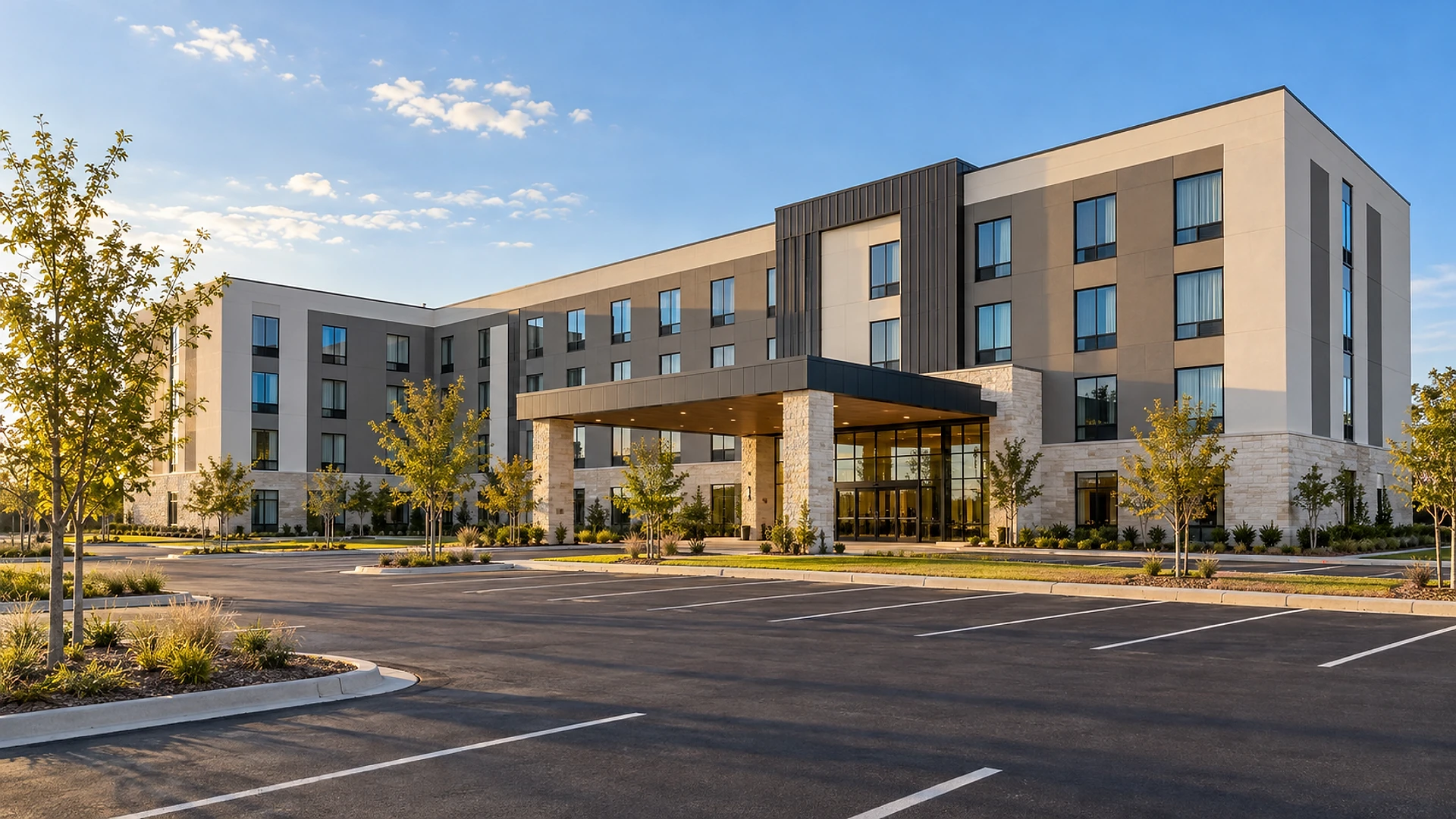
The right choice between an extended-stay and a select-service hotel on a Texas lot comes down to land, parking and guests. Extended-stay suits a larger site, a market full of 5-night-plus stays and room to park more cars. Select-service suits a tighter lot and shorter trips. The kitchen is what separates them, and it changes the building more than most owners expect.
A select-service hotel is the kind most people know: a lobby, a free breakfast, a pool and rooms with a bed, a desk and a bathroom. An extended-stay hotel is built for guests who stay a week, a month or longer, so each room is a small apartment with a kitchen. Both are common brands across Texas, and both can look like the same 4-story block from the highway.
This guide is for owners and investors who have a lot, or a contract on one, and haven't picked a hotel type yet. It's the kind of question we answer in our feasibility work, before drawings start and while changing course is still cheap.
Key takeaways
- A kitchen adds plumbing, power and floor area to every room. It also adds a vent and, often, a larger room, and that repeats on every key (hotel talk for a rentable room).
- Extended-stay usually needs more land per room. Suites are bigger and more guests keep a car on site for weeks.
- Taxes work differently. In Texas, a guest who stays 30 consecutive days or more generally doesn't pay state or local hotel occupancy tax.
- Your city may treat the 2 types differently. Some Texas cities define extended-stay separately and set their own rules for parking, room size and site size.
- Run the lot test first. If the land won't hold the parking, the choice is already made.
Select-service
A lobby, a breakfast area, a pool and a small meeting room. Rooms have a bed, a desk and a mini-fridge. Guests stay 1 to 3 nights. A small team runs it.
Extended-stay
Fewer shared spaces, bigger rooms and a kitchen in each one. Guests stay 5 nights, 30 nights or more. Housekeeping is lighter, often weekly.
Full-service
A restaurant on site, large meeting space and a bigger staff. A very different project, so we leave it out of this guide.
What does a kitchen change inside the room?
A kitchen turns a hotel room into a small apartment. That means a sink with a drain, a cooktop or stove, a fridge, counters and a table, and every one of them lands in the wall plan and the budget.
Start with the pipes. A select-service room has 1 bathroom, so water and drains stack neatly in 1 wall. A suite adds a kitchen sink, and the drain has to meet the bathroom's drain run, which usually means a second wet wall or a wider one. Then the power: a stove or cooktop wants bigger circuits than a lamp and a TV, and the panel for the floor has to be sized for hundreds of them at once.
Then the air. A cooktop makes steam, smoke and grease, so it needs a vent that goes somewhere. In a 4-story building, those vents run through the roof or the outside wall, and each one has to be fire-sealed where it passes through floors.
The last piece is easy to miss: smoke alarms. Place one too close to a cooktop and toast sets it off at 7 a.m. Place it too far and it doesn't protect the guest. Our engineering team works this out on the drawings, as part of the same agreement as the architecture.
Notice how the suite grows to make space. The kitchen run takes a whole wall, the table needs its own corner and the bed moves. Even with identical bathrooms, the extended-stay room needs more floor area, and the extra area is multiplied by every room in the building. For a view of the other half of the building, our plain-English hotel glossary explains terms like keys, brand standards and the roll-in shower.
How much land does each hotel type need?
More for extended-stay, usually by 20% to 40% per room. The suites are larger, the parking ratio is often higher and the extra pavement takes space that no one sees from the road.
Land is the cost most owners see last, so test it first. Start with how many rooms the brand or the market wants. A 100-room select-service hotel often fits on roughly 1 to 1.5 acres. The same room count in extended-stay can push toward 1.5 to 2 acres once the extra parking and the bigger footprint are in. Drag the slider to see how room count moves the numbers.
- Land, select-service40,000–65,000 sq ftAbout 400–650 sq ft of land per room, parking included
- Land, extended-stay50,000–85,000 sq ftAbout 500–850 sq ft per room, because suites are bigger and more guests keep a car
- Building and site work, select-service$12,000,000–$19,000,000Land not included
- Building and site work, extended-stay$10,000,000–$17,000,000Land not included, midscale brand
- Parking spaces, select-service100–120 spacesAbout 1 per room, plus a few extra for staff
- Parking spaces, extended-stay110–160 spacesOften above 1 per room, and some city codes ask for more
Planning ranges only. Your city's parking rules, the brand's standards and the shape of the lot will move every number.
Planning ranges, not a project quote. Cost and timing vary with owner decisions, project complexity, market conditions, and jurisdiction workload.
The parking number deserves the second look. Some Texas cities ask for more spaces per room for extended-stay hotels than for regular ones, and some don't allow a parking garage for them at all. If you find that rule after you've closed on the land, the cheapest fix is a smaller hotel. Our article on feasibility for apartment sites walks through the same land-first thinking for another sleeping use.
What does each type cost to build?
The gap is smaller than you'd think and it shifts between surveys. Midscale extended-stay often comes in at or below select-service per room, and upscale extended-stay costs more.
Trade press reported on Marriott's 2 recent extended-stay designs in 2023, and put them at roughly $110,000 and $158,000 a room to build, before land, as Hotel Dive described it. Those are brand prototypes, built to a tight budget. A real site adds soil work, utilities, stormwater ponds and your city's rules, so the ranges below are wider.
Why can extended-stay cost less per room despite the kitchens? Because it usually leaves out expensive shared space. Guests don't expect a large breakfast room, a big meeting room or a large lobby lounge, so a bigger share of the building is rooms that earn rent. Marriott said about 76% of its cheaper prototype's floor area goes to revenue space.
Why can it cost more? Because every room has more in it. The kitchen items, the vents, the bigger electrical panels and the larger rooms all repeat across 100 or more keys. A small change in a single room becomes a large change in the budget. We show owners both on a single sheet before they sign a franchise agreement. For a related look at what a 1-room change does to a whole hotel, see our hotel renovation myths article.
How do the 2 types differ on taxes, codes and approvals?
They differ in 3 places: tax, zoning and room design. Everything else, from fire sprinklers to accessible parking, is the same for both.
| Topic | Select-service | Extended-stay |
|---|---|---|
| Typical guest stay | 1 to 3 nights | 5 nights to 30 nights or more |
| Hotel occupancy tax | Charged on every night | Not charged once a guest stays 30 nights in a row |
| Kitchen in the room | Mini-fridge and microwave | Sink, cooktop, fridge and counter |
| Parking | About 1 space per room | Often more, set by your city |
| Zoning | Counted as a hotel | Some cities treat it as its own use |
| Shared space | Breakfast area, lobby, small meeting room | Small lobby, guest laundry, little else |
| Accessible rooms | Roll-in showers and clear floor space | The same, plus a kitchen a wheelchair user can use |
Tax. Under Texas Tax Code Section 156.101, a person who has the right to use a hotel room for at least 30 consecutive days, with no gap in payment, isn't charged the state hotel tax. The Comptroller's hotel tax FAQ explains how the 30 days are counted and how a guest gives written notice. Local hotel taxes follow the same exemption. That doesn't change what you build, but it does change the revenue model, so your accountant should see it before the numbers go to a lender.
Zoning. Some Texas cities define an extended-stay hotel separately from a regular one. The test is often how many rooms have a kitchen, and the rules can set a minimum site size, a minimum room size, a higher parking ratio or a distance from homes. A call to the planning office before you buy is worth more than any report.
Accessible rooms. Both types must provide accessible rooms and roll-in showers under the federal 2010 ADA Standards for Accessible Design. In an extended-stay suite, the kitchen in an accessible room also has to be usable from a wheelchair, with clear floor space and reachable controls. Projects of $50,000 or more in Texas also go to the state for an accessibility design review, as the Texas Department of Licensing and Regulation's frequently asked questions explain. We cover how that works in our article on TDLR accessibility review.
Franchise brands set their own rules: a minimum number of rooms, a site size, a protected area where no other hotel of the same brand can open, and a prototype building. Get the brand's site checklist in writing before your option period ends. If the lot doesn't pass, you want to know now.
Who stays in each type, and why does it matter for design?
Select-service fills with short business trips, family visits and travelers passing through. Extended-stay fills with people who live somewhere else for a while: traveling nurses, project crews, families between homes and employees on a long assignment.
That difference drives design. A 3-night guest wants a quick check-in, a good bed and a hot breakfast. A 30-night guest wants a real desk, a full-size fridge, a washer nearby and a parking space that's still there tomorrow. The lobby shrinks and the laundry room grows. The front desk can be a small counter, and the corridor is quieter because people go in and out less often.
The location matters just as much. Select-service wants to be near an exit, an airport or a busy road. Extended-stay wants to be near the work: a hospital cluster, an industrial area, a training campus or a major employer. Ask who will stay and for how long before you ask what to build.
How do you decide? Run these 5 tests in order
Run the 5 tests below, in this order, on your actual lot. Each one can end the discussion. The cheapest answer comes first, and the most expensive one, the building design, comes last.
- 01
Land
Draw the largest hotel that fits with the parking your city requires, for both types
- 02
Zoning
Ask the planning office how it classifies each type and what it requires
- 03
Demand
Find out who will stay: stay length, nearby employers, hospitals, projects
- 04
Brand
Check each brand's site, room count and protected area rules in writing
- 05
Budget
Price both on a single sheet: cost per room, land per room, rent per room
Test 1: land. Draw the building footprint and the parking on the lot before anything else. If extended-stay needs 120 spaces and the lot holds 95, you have your answer. If both fit, move on.
Test 2: zoning. Call or email the planning office and ask 3 things: how does the code treat extended-stay, what is the parking ratio, and does the lot's zoning allow either type. Get the answer in writing. A simple email counts.
Test 3: demand. Count the reasons someone would sleep near your lot for a month. A hospital, a plant, a large construction project, a university or a corporate campus within a short drive is a strong sign. A single highway exit with nothing else nearby is a sign for select-service.
Test 4: brand. Each hotel brand has a site checklist and a protected area. 2 lots in the same city can pass for one brand and fail for another. This is a business step, but an architect should read the checklist, since much of it is about the building and the site.
Test 5: budget. Put both options on a single sheet with the same inputs: rooms, land, building cost, parking cost and expected rate. Don't compare cost per room alone. A cheaper room that needs 30% more land isn't cheaper. Our architecture team can turn a short sketch of each into a price range in days, not months.
“Pick the guest first.
Then pick the building.”
Which mistakes cost owners the most?
3 show up again and again. First, owners fall for a single brand and buy a lot before checking the site rules. Second, they price the building and forget the parking. Third, they assume a hotel is a hotel for code purposes, then learn in the city's review that a building meant for long stays can be treated more like an apartment building in some respects.
A fourth, quieter mistake is waiting. Every one of these tests is cheap in week 1 and expensive in month 6, after the land contract is firm and the drawings are half done. If you're still inside an option period, use it. A 2-page feasibility study that settles land, parking, zoning and a first budget is the cheapest piece of paper in the whole project.
Questions hotel owners ask about extended-stay and select-service
What's the difference between an extended-stay and a select-service hotel?
A select-service hotel offers a lobby, a breakfast area and basic rooms for short stays. An extended-stay hotel has bigger rooms with a kitchen, fewer shared spaces and lighter housekeeping, and it's built for guests who stay 5 nights or longer. Both can look the same from the street.
Which costs less to build, extended-stay or select-service?
It depends on the brand level. Midscale extended-stay often costs the same or less per room, because it leaves out large shared spaces. Upscale extended-stay costs more. Compare total cost for the same number of rooms, including land and parking, rather than cost per room alone.
How much land does a 100-room hotel need?
Often about 1 to 1.5 acres for select-service and about 1.5 to 2 acres for extended-stay, depending on parking rules, the shape of the lot and stormwater needs. These are planning ranges, and a quick site layout gives you a real number for your lot.
Do guests in extended-stay hotels pay hotel tax in Texas?
Generally not after 30 consecutive nights. Texas law exempts a person who has the right to use a room for at least 30 consecutive days with no gap in payment, and the Comptroller explains how written notice and day counts work. Guests staying fewer than 30 nights are taxed as usual.
Does a kitchen change the building permit?
Yes, in several ways. A kitchen adds plumbing, a cooktop vent, larger electrical circuits and a different smoke alarm plan. It can also change how your city classifies the use. The drawings show each of these, and the city reviews them with the rest of the permit.
Do extended-stay hotels need more parking?
Often yes. Guests who stay for weeks keep a car on site every night, so many cities set a higher number of spaces per room for extended-stay. Others treat it like any hotel. Check your city's code before you buy the land.
Are extended-stay hotels treated differently by Texas cities?
In some cities, yes. Zoning codes may define extended-stay by how many rooms have a kitchen, then set rules for site size, room size, parking or location. Ask the planning office how your lot is classified.
What accessibility rules apply to a hotel kitchen?
Accessible rooms must meet the federal ADA standards for hotel guest rooms, including a kitchen that a person using a wheelchair can reach and use. Projects at or above $50,000 in Texas are also reviewed by the state's accessibility program.
Can I switch from select-service to extended-stay later?
Possible, but costly. The kitchen means new plumbing, vents and electrical work in every room, and the parking may no longer be enough. Decide before drawings start, and design the building around that choice from the first day.
Got a lot and a hotel idea? Start with a 2-page test
If you have a lot, or a contract on one, send us the address and the brands you're considering. We'll run the land, zoning and budget tests for both hotel types and tell you which one the lot supports, what each is likely to cost and which questions to ask the city and the brand first. You'll have a plain answer before the option period runs out.
To see the kind of projects we take on, visit our hospitality architecture work.
