
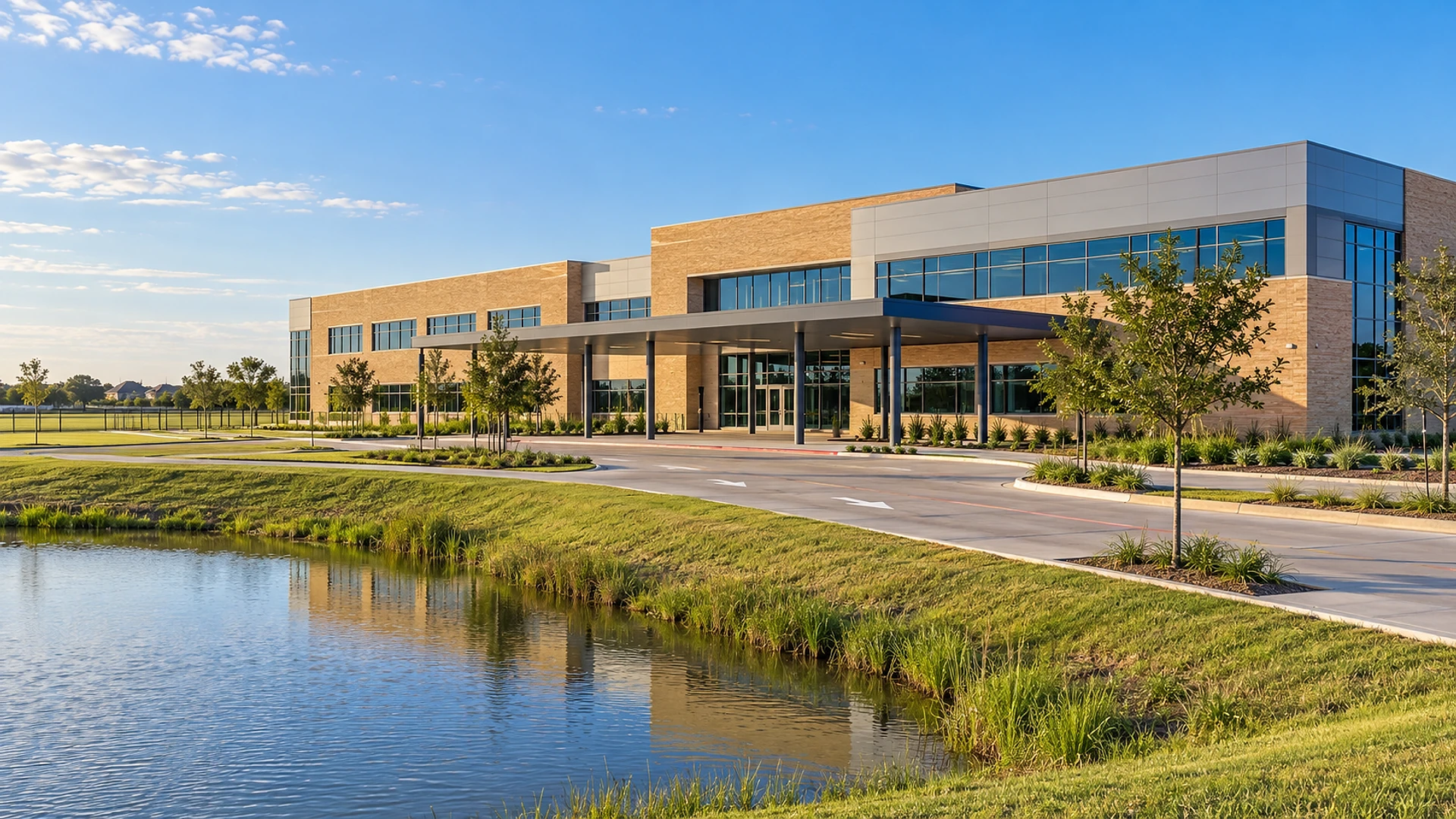
A Houston school site is feasible when 7 things check out before you buy or sign: the deed restrictions, the flood risk, the size, the car line, the utilities, the building and the budget. Run those checks in order, during your option or due diligence period, and you will know whether the land can hold the school you need, or whether to walk away while it is still cheap to do so.
Charter and private school founders tend to fall in love with a site for good reasons. It is near the families they serve, it is on a busy road people already drive, and the price looks fair. But a school is one of the hardest buildings to fit on a piece of land. It needs room for a building, a play area, parking, a stormwater pond and, above all, space for a line of cars that shows up all at once, twice a day.
This playbook is the order we work in when a school asks us to test a site through our feasibility and due diligence service. It assumes Houston and the nearby counties, where the rules are a little different from the rest of Texas.
- Steps in the playbook
- 7
- Typical study length
- 3-6 weeks
- Site size for 400-600 students
- 3-6 acres
- Most common deal-breaker
- The car line
What should you know before you start?
- Houston has no zoning, but private deed restrictions can still ban a school outright. Read them first.
- Flood risk and stormwater rules can take 10–25% of a site off the table before you draw anything.
- The car line, the queue of parents dropping off and picking up, decides more school sites than the building does.
- Water, sewer and fire flow (enough water pressure for firefighting) need to be confirmed, not assumed.
- An existing building can save time, but only if it can meet the building code's rules for schools.
- A good study ends with a clear answer: buy, renegotiate or walk away.
Do the deed restrictions allow a school?
Start with the paperwork, because it can end the conversation in a day. The City of Houston has no zoning, which surprises many founders who move here from other cities. That doesn't mean anything goes. Much of Houston is covered by deed restrictions, private rules written into the property records that limit what can be built. The city's own deed restriction page explains that they bind every future owner, and the city can help enforce some of them.
A restriction that says "residential use only" or "single-family only" usually rules out a school. Others limit height, building lines or driveways. We ask for the title report and every recorded restriction listed in it, then read them line by line. If the site is in a nearby city such as Sugar Land, Pearland or Katy, that city may have zoning on top of any deed restrictions, and a school might need a special permit there.
It is also worth checking the Texas Education Code chapter on charter schools with your attorney. State law treats charter schools a little differently from private ones in some local matters, and that can change what a city is allowed to require.
- 01
Deed restrictions
can a school legally go here at all?
- 02
Flood risk and stormwater
how much land is left after the water is handled?
- 03
Size and shape
do the building, play area and parking fit?
- 04
The car line
can the morning queue stay off the street?
- 05
Utilities and fire flow
is there enough water, sewer and pressure?
- 06
The building
new build, or an existing building converted?
- 07
Budget and verdict
buy, renegotiate or walk away
How much of the site does water take?
Houston is flat and wet, so water planning shapes every site. First we check whether any part of the land sits in a mapped floodplain using the Harris County Flood Control District's mapping tool. Building in a floodplain is sometimes possible, but it adds fill, raised floors and review time. For a school full of children, we usually advise staying out of it.
Next comes the stormwater pond, the basin that holds rainwater from roofs and paving and lets it drain away slowly so the street doesn't flood. Houston-area rules usually require one when you add hard surfaces. On a typical school site, the pond and its slopes can use 10–25% of the land. That is land you pay for but can't put a classroom or a play field on.
If you are new to how land gets tested in this part of Texas, our walk-through of industrial land due diligence in Houston covers the same flood and drainage checks in more depth.
Is the site big enough, and the right shape?
Once the water is handled, we look at what's left. A school needs 4 big pieces: the building, an outdoor play area, staff and visitor parking, and the car line. The building is usually the smallest of the 4 on the ground.
Shape matters as much as size. A long, narrow site along a busy road can be easier to work with than a square one, because it gives the car line room to stretch. A site with only 1 short frontage, a pipeline easement through the middle, or a big tree stand you want to keep can lose half its useful area. We sketch 2–3 rough layouts on the survey to see which one works, the way a test fit works for an office lease.
Drag the slider to see how the land needs grow as the school grows.
- Building size45,000–60,000 sq ftClassrooms, offices, cafeteria and a multipurpose room
- Land needed3–6 acresBuilding, play area, parking, pond and car line together
- Car line space on the site1,500–2,800 feetRoom for the morning queue, measured along the drive lane
- Staff and visitor parking40–75 spaces
Planning ranges only. A 2-story building, shared play space or a staggered start time can shrink the land you need. A gym, a stadium or a high school with student drivers can grow it.
Planning ranges, not a project quote. Cost and timing vary with owner decisions, project complexity, market conditions, and jurisdiction workload.
Where does the car line go?
This is the step that sinks the most school sites, and the one founders think about last. The car line is the queue of parents dropping children off in the morning and picking them up in the afternoon. At most charter and private schools, few students ride a bus, so nearly every child arrives by car, and most arrive within about 20 minutes.
If the line doesn't fit on your site, it backs up onto the public street. That blocks traffic, angers neighbors and can put the school at odds with the city or with the Texas Department of Transportation if the road is a state highway. Fixing it after opening means staggered start times, extra staff directing cars, or rebuilding the driveway. Planning it before you buy means a better site or a better price.
We lay out the car line as a long, looping drive lane that stays on the property, ends at a covered drop-off point at the front door, and leaves by a separate exit. A drive-thru restaurant faces the same problem on a smaller scale, which is why our drive-thru site plan article talks about queue length the same way.
Before the study ends, we visit the site between 7:15 and 8:15 on a school morning and again around 3:00 in the afternoon. Nearby schools, shift changes at local employers and left turns across busy lanes all show up then, and none of them show up on a map.
Are water, sewer and fire flow really there?
A school needs more water than most buildings its size: restrooms, a kitchen or warming kitchen, drinking fountains and, often, fire sprinklers. Our engineering team checks 3 things with the utility provider before you commit:
Is there a water line big enough?
A line in the street isn't the same as a line with enough capacity. We confirm the size and the pressure.
Is there sewer service nearby?
Some sites on the edge of the Houston area depend on a utility district or need a long sewer extension. That can add months and a large check.
Is there enough fire flow?
Fire flow means the amount of water a fire hydrant can deliver for firefighting. If it is too low, you may need a bigger line, a fire pump or a water tank, and each adds real cost.
Architecture and engineering come from one team here, so these answers feed straight into the layout instead of arriving weeks later in a separate report.
New building, or an existing one?
Many charter schools start in an existing building, often an old office, a shopping center space or a light warehouse. Converting can be faster, but a school is a different use under the building code, with stricter rules for exits, fire alarms, sprinklers, restrooms and classroom sizes. A building that worked well as an office might need new stairs, a new fire alarm, more toilets and a storm shelter before children can use it.
| Question | Converting an existing building | Building new |
|---|---|---|
| Speed to opening | Often 9–15 months | Often 18–30 months |
| Code upgrades | Can be large and hard to predict until walls open | Designed in from the start |
| Car line and play area | Limited by what is already paved and built | Laid out to suit the school |
| Long-term fit | Classrooms shaped around old walls | Classrooms sized for teaching |
| Best when | The building is sound and the site has room for the car line | No good building exists, or you want room to grow |
New schools in Texas have some extra steps too, including state accessibility review. Commercial projects over a set cost must be registered with the Texas Department of Licensing and Regulation's accessibility program, reviewed, and inspected after construction. Our backward timeline for a new Texas school building shows where those steps land.
What will it cost, and should you buy?
The last step turns everything into a number and a recommendation. Land is only the first check. The site work, meaning the pond, paving, driveways, utilities and the car line, can be a surprisingly large share of a school budget in the Houston area, because flat land drains slowly and every car needs a paved lane.
We end every study with 1 of 3 calls. Buy when the site fits and the numbers work. Renegotiate when the site works but needs extra pond, a sewer extension or a longer driveway the seller should help pay for. Walk away when a deed restriction, a flood map or the car line can't be solved at a sensible cost. If you go ahead, the same study becomes the start of architecture and design for the school.
“The cheapest site isn't the one with the lowest price.
It is the one that doesn't surprise you.”
Questions founders ask about school sites in Houston
Can I build a school anywhere in Houston since there is no zoning?
No. The city has no zoning, but private deed restrictions cover much of Houston and can ban schools or other non-residential uses. Nearby cities often have zoning too. Always read the title report and recorded restrictions before you buy.
How many acres does a charter school need?
It depends on the number of students, the grades and how many stories you build. As a planning range, a school for 400–600 students often needs about 3–6 acres once you add the building, play area, parking, stormwater pond and car line. High schools with sports fields and student parking need more.
What is a car line, and why does it matter so much?
A car line is the queue of parents dropping off and picking up students. Because most charter and private school students arrive by car within a short window, the line can stretch hundreds of feet. If it doesn't fit on your site, it backs onto the street, which causes traffic and neighbor problems that are hard to fix later.
How long does a school site feasibility study take?
Most studies take about 3–6 weeks, depending on how quickly the title report, survey and utility answers come back. We plan the work so the key answers arrive before your option or due diligence period ends.
Can a charter school move into an existing office or retail building?
Often yes, but the building must meet the code's rules for schools, which are stricter on exits, fire alarms, sprinklers, restrooms and, for some schools, storm shelters. A walk-through with an architect and engineering team before you sign can show how big those upgrades are.
Do I need a traffic study for a new school?
Many schools do, especially on busy roads or state highways, and the city or state may ask for one before approving driveways. Even when it isn't required, a simple study of the car line and turning movements is worth doing before you buy.
What happens if the site is in a floodplain?
Building in a mapped floodplain usually means raising the building, adding fill and meeting extra review steps, all of which add cost and time. For a school, we generally recommend choosing a site outside the floodplain when you can.
Should I get a feasibility study before signing a purchase contract?
Ideally, sign the contract with an option or due diligence period long enough to finish the study, often 30–90 days. That lets you walk away or renegotiate based on real findings instead of guesses.
Have a site in mind for your school?
Send us the address, the survey if you have one, and how many students you plan to serve in year 1 and at full size. We'll tell you which of the 7 steps look risky and what it would take to answer them before your deadline. Architecture and engineering come from one team, so the car line, the pond, the utilities and the building are tested together. You can read more about our work with schools and other institutional clients, or start the conversation today.
