
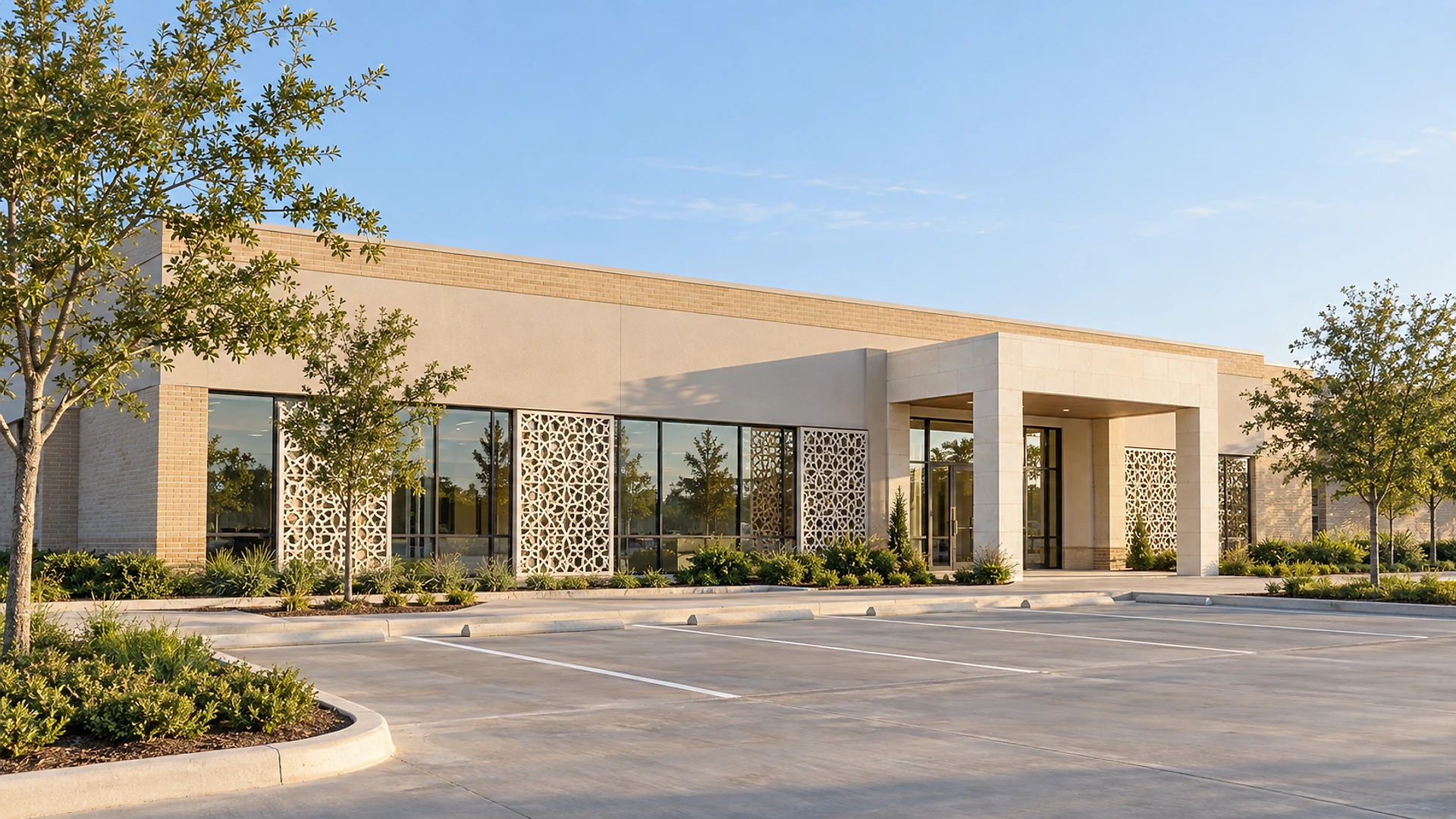
Converting an existing building into a mosque is usually faster and cheaper up front than building new, but only when the zoning, parking, fire code and direction of prayer all work in that building. When even 1 of those fails, the conversion can cost close to a new building and take nearly as long. Building new costs more and takes longer, but the prayer hall, wudu area and parking fit the community exactly. The right answer comes from testing a specific building before you buy it, not from the asking price.
We hear this question from mosque boards across Texas every few months. A former grocery, gym or office building comes on the market at a good price, and the community wants to know if it can be ready for Ramadan. Sometimes it can. This guide walks through how we help a community decide, as part of our feasibility and due diligence work. Every number here is a planning range, not a quote.
Key takeaways
- Converting is faster only if the building passes 4 tests: the city allows a place of worship there, the lot has enough parking for Friday prayer, the fire code changes are affordable and the room works for prayer rows.
- A store or office becomes a different code group as a prayer hall. That change can bring fire sprinklers, a fire alarm, more exits and more toilets.
- The direction of prayer matters to the layout. In most of Texas it is roughly northeast, so rows in a building set square to the street run on a slant.
- Wudu needs real plumbing: water, drains and waterproof floors that most stores and offices never had.
- Federal and Texas law protect places of worship in zoning, but those laws do not waive parking, fire or building code rules.
Should your community buy a building or build new?
There are 2 paths, and each one fits a different situation. Converting means buying or leasing an existing commercial building and changing its use to a mosque. Building new means buying land and designing a building from the ground up.
The difference in time is usually the deciding factor. A conversion with no zoning hearing and light construction can open in 9–18 months from purchase. A new building on raw land usually takes 24–42 months, because it adds site design, stormwater review and a full building permit before construction even starts.
- Convert and open
- 9–18 months
- Build new and open
- 24–42 months
- Open prayer floor per person
- About 7 sq ft
- Fire sprinklers often needed from
- 300 people
Cost follows the same pattern, but with more overlap than most boards expect. A building that needs only new carpet, wudu stations and restrooms is far cheaper than new construction. A building that needs a full sprinkler system, a new roof, more exits and more parking can end up within 15–25% of the cost of building new, and you still have a building that was designed for something else.
| What matters | Convert an existing building | Build new on land |
|---|---|---|
| Time to first prayer | About 9–18 months | About 24–42 months |
| Upfront cost | Lower, if the building passes the 4 tests | Higher, but fewer surprises |
| Prayer direction | Rows may run on a slant | Building faces the right way from day 1 |
| Parking | Fixed by the lot you buy | Planned for Friday prayer from the start |
| Wudu and restrooms | Added into an existing floor | Designed in from the first sketch |
| Room to grow | Limited by the building and lot | Phases planned on the site |
If your community is leaning toward building new, our walk-through of a hypothetical mosque built in phases shows the stages from land search to opening day. The rest of this guide focuses on how to test a building before you buy it.
Will the city let you use the building as a mosque?
Zoning is the first test because it can stop a project outright. Zoning is a city's set of rules about what uses are allowed on each piece of land. Many Texas cities allow places of worship in some districts by right, meaning no special approval is needed. In other districts they require a special permit, often called a specific use permit or conditional use permit, which means a public hearing and a council vote. That process alone can add 3–6 months.
Houston is the well-known exception: it has no zoning map. But that does not mean anything goes. Many Houston-area properties carry deed restrictions, private rules recorded with the land that can limit the use, and some suburban cities around it do have zoning. We read the zoning and the recorded restrictions for every building before a community makes an offer.
What federal and Texas law protect
A federal law called the Religious Land Use and Institutionalized Persons Act, usually shortened to RLUIPA, protects religious assemblies in zoning decisions. The U.S. Department of Justice summary of RLUIPA explains its main rules: a city cannot treat a religious assembly worse than a nonreligious assembly, such as a theater or event hall, and it cannot place a substantial burden on religious exercise without a very strong reason. Texas has its own Religious Freedom Restoration Act, which adds similar protection against state and local rules.
These laws matter, but they protect against unfair treatment. They do not waive the building code, the fire code or reasonable parking rules that apply to every assembly use. When a zoning question looks difficult, we bring in your attorney early, before the purchase closes.
What changes when a store or office becomes a prayer hall?
Every building is classified by the building code according to how it is used. A store is a mercantile use and an office is a business use. A prayer hall is an assembly use, called Group A-3 in the International Building Code, the code most Texas cities adopt. Changing from 1 group to another is called a change of occupancy, and it is the moment the city looks at the building with fresh eyes.
How many people the room holds
The code counts people by floor area. For an open floor with no fixed seats, the figure most reviewers use is about 7 sq ft per person. A 6,000 sq ft prayer hall can therefore be counted at roughly 850 people, far more than the 100 or so the same floor held as a store. That number drives almost everything else on this list.
What the new count can trigger
- Fire sprinklers. An A-3 space generally needs sprinklers once it holds 300 or more people, or once the fire area passes 12,000 sq ft. Many former stores have no sprinklers, and adding them can mean a new water line from the street.
- A fire alarm. Assembly spaces for 300 or more people also need a manual fire alarm system.
- Exits. Rooms for more than 49 people need at least 2 exits placed far apart, and very large rooms need 3 or 4. Doors must swing outward and have push-to-open hardware.
- Restrooms. The plumbing code asks for more toilets and sinks for an assembly use than for a store or office.
Many of these same changes apply when a store becomes an event venue; our guide to turning an empty store into an event hall covers exits and sprinklers in more detail.
Accessibility
Texas has its own accessibility rules, the Texas Accessibility Standards, run by the Texas Department of Licensing and Regulation (TDLR). The state rules exempt the areas of a religious organization's building used mainly for religious ritual, such as the prayer floor itself. But the parking, entrances, restrooms, wudu area, classrooms and offices are still covered, and the city's building code has its own accessibility chapter. Our article on TDLR accessibility review explains when state registration and review apply.
Does the room actually work for prayer?
A building can pass every code test and still be a poor mosque. 2 things make the difference: which way the rows face, and where people make wudu.
The direction of prayer
From most of Texas, the qibla, the direction of prayer toward Makkah, is roughly northeast, about 35–46 degrees east of north depending on the city. Most commercial buildings are set square to their street, so the walls almost never line up with that direction. The prayer rows then run on a slant across the room. The front row gets shorter, the prayer niche, or mihrab, sits in a corner rather than the middle of a wall, and some floor area ends up as leftover triangles.
Before an offer, we draw the prayer rows on the building's actual plan at the community's chosen direction, count how many people fit in straight rows and place the mihrab, the imam's spot and the entrance. A building that looks like 8,000 sq ft of prayer space can lose 10–20% of its rows to a slant, columns and leftover corners.
Columns matter too. Older retail buildings often have steel columns every 25–40 feet, and each one breaks a row. A wide open room with few columns is worth more to a mosque than a bigger room full of them.
Wudu and plumbing
Wudu, the washing before prayer, needs a dedicated area with low seats, faucets, floor drains and floors and walls that can stay wet. A former store usually has 1 or 2 restrooms and a single sewer line in 1 corner. Bringing water and drains to a wudu area across the building can mean cutting a trench in the concrete slab. We look at where the sewer leaves the building and plan the wudu and restrooms near it, which can save a large share of the plumbing cost.
Is there enough parking for Friday prayer?
Parking is the test that fails most often. A mosque's peak is Jumu'ah, the Friday midday prayer, and in Ramadan the nightly prayers and Eid can bring even bigger crowds. Many Texas cities set mosque parking at about 1 space for every 3–5 people in the prayer hall, or a set number of spaces per 1,000 sq ft of prayer floor. A 6,000 sq ft prayer hall can need 150–280 spaces.
A former store with 60 spaces will not meet that. There are options: a written shared parking agreement with a neighbor whose busy hours are different, such as a shop or venue that opens only in the evenings, buying an adjacent lot, or limiting the prayer floor to what the parking supports. Each option has to be confirmed with the city before you buy, not after. The city will not issue a certificate of occupancy, the permit that allows people to use the building, until the parking for the new use is in place.
Which questions decide it for your community?
When we run a feasibility study on a building, these 6 questions decide whether converting makes sense. If the answers are mostly yes, converting usually wins. If 2 or more are no, building new is often the better use of the community's money.
- 01
Zoning
Is a place of worship allowed here by right, or does it need a public hearing and a council vote?
- 02
Recorded restrictions
Do deed restrictions or shopping-center rules limit the use or the hours?
- 03
Parking
Does the lot, or a written shared parking deal, cover Friday prayer and Eid?
- 04
Fire code
Can the building take sprinklers, an alarm and more exits at a sensible cost?
- 05
Prayer layout
How many people fit in straight rows facing the right way, around the columns?
- 06
Wudu and restrooms
Can water, drains and wet floors reach the right spot without rebuilding the slab?
A focused study of 3–6 weeks answers all 6 for a small fraction of the purchase price. We fit that study inside the seller's option period, the window when you can still walk away with most of your deposit.
What does each path really cost?
Compare the whole project, not the asking price against a construction estimate. For a conversion, add the purchase price, the work, design, permits, any added parking and a contingency. For a new building, add land, site and stormwater work, construction, design and permits. The ranges below show how those totals often fall per sq ft of finished building in Texas. They vary widely by city, building age and condition.
The overlap between heavy conversion and building new is the reason the 6 tests matter. A building bought at a low price that needs a new roof, sprinklers, a new water line, a slab trench for wudu and a second parking lot can cost almost as much as a new mosque, and still face the wrong way.
“The price on the listing is only half the number.
The other half is what the building needs to become a mosque.”
Texas also offers a property tax exemption for buildings used for regular religious worship, set out in Chapter 11 of the Texas Tax Code. The community must qualify and apply to the county appraisal district; it is not automatic.
What should your board check before signing?
The most expensive mistake is closing on a building and only then asking the city what it will take. Here is the list we work through with a board before the option period ends.
- Zoning allows a place of worship, or the hearing path is mapped
- Deed and center restrictions read in full
- Parking count for Friday prayer confirmed with the city
- Fire sprinkler and alarm needs and the water supply checked
- Exits counted for the full prayer floor
- Prayer rows drawn at the right direction around the columns
- Sewer and water located for wudu and restrooms
- Roof, air conditioning and electrical condition reviewed
- Total budget for both paths side by side
If the building passes, our architecture team, with structural, mechanical, electrical and plumbing engineering as one team, takes it straight into design and permits. If it fails, the community has spent a few weeks and a small fee, not its building fund. You can see the rest of our work for mosques, Islamic centers and schools on our institutional sector page.
Frequently asked questions
Not every one. The building has to be in a location where a place of worship is allowed, have enough parking for the peak prayer, and be able to take the fire safety upgrades an assembly use needs. A short feasibility study answers those questions before you commit.
Converting is usually cheaper up front when the building needs light work. When it needs sprinklers, more exits, a new roof, new plumbing and more parking, the total can come close to building new. Compare the full cost of both paths, not the purchase price against construction alone.
A conversion with no zoning hearing and modest construction often takes about 9–18 months from purchase to opening. A specific use permit hearing can add 3–6 months. Building new on raw land usually takes 24–42 months.
Often, yes. Under the building code most Texas cities use, an assembly space generally needs sprinklers once it holds 300 or more people or the fire area passes 12,000 sq ft. Because an open prayer floor is counted at about 7 sq ft per person, many prayer halls reach that number quickly.
It depends on the city. Many Texas cities set it at about 1 space for every 3–5 people in the prayer hall, or a set number per 1,000 sq ft of prayer floor. Shared parking agreements with neighbors can help, but the city must accept them before you buy.
A city can apply its normal zoning, parking and safety rules, but federal law (RLUIPA) and the Texas Religious Freedom Restoration Act prevent it from treating a religious assembly worse than a nonreligious one or placing an unjustified burden on worship. If a zoning question looks difficult, involve an attorney before closing.
Most buildings do not. The prayer rows can be laid on a slant inside the room, with the mihrab in a corner or on an angled wall. We draw the rows on the real plan before you buy so you know how many people fit.
Partly. Texas accessibility rules exempt areas used mainly for religious ritual, such as the prayer floor, but parking, entrances, restrooms, wudu areas, classrooms and offices are still covered. The local building code's accessibility chapter applies as well.
Looking at a building for your community?
If your board has a building in mind, or is choosing between a building and a piece of land, we can run the 6 tests inside your option period and show you both paths side by side. Architecture and engineering come from one team, so the answer covers zoning, code, prayer layout, plumbing and parking in a single study. Contact us with the address and your expected Friday attendance, and we will tell you what we would check first.
