
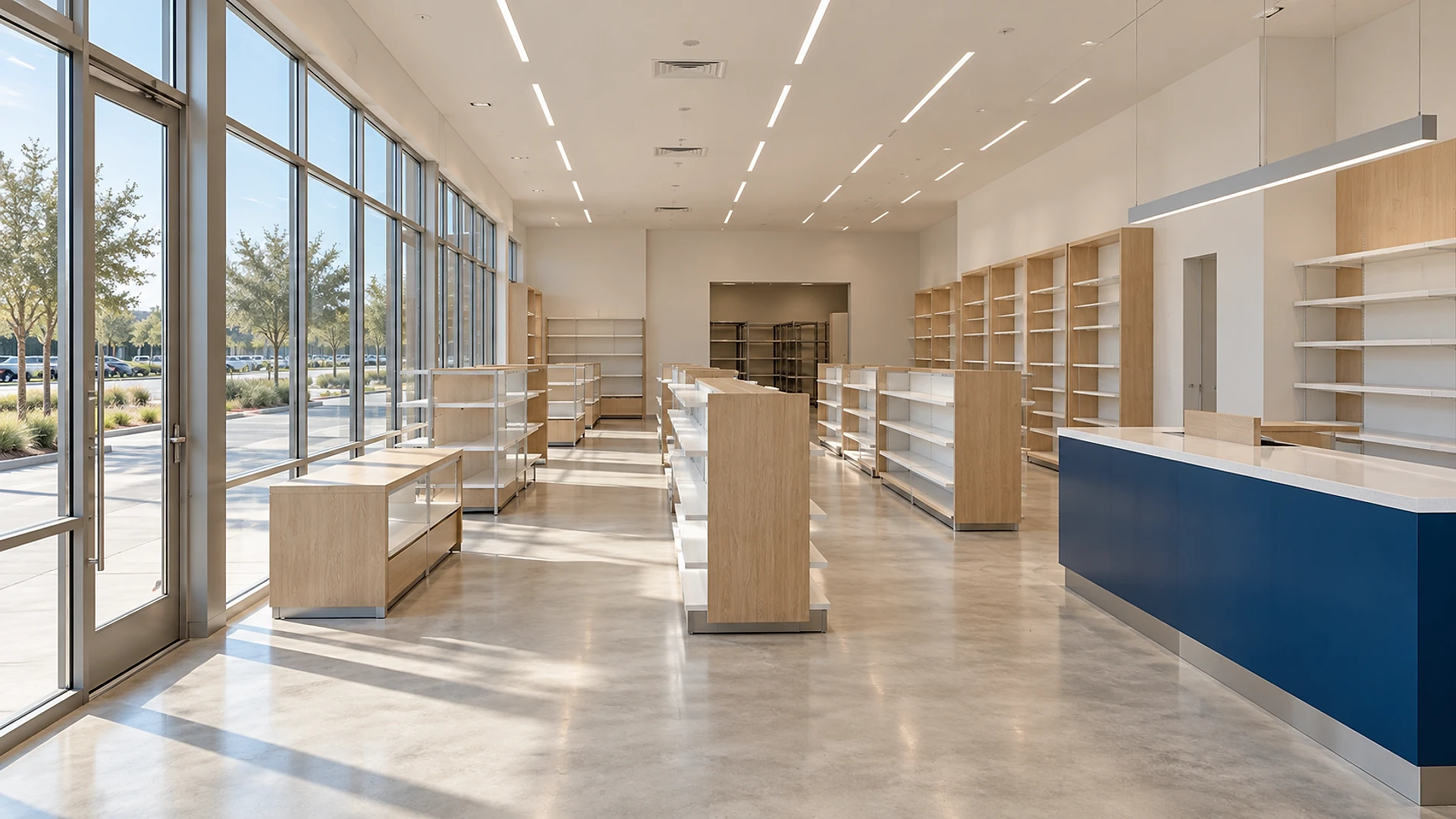
A retail store rollout across Texas usually takes 12–20 months for 5 stores, and the risk sits between the stores, not inside them. Each store has its own lease, landlord, city permit, state accessibility review and crew, and an owner's representative keeps 1 standard store design, 1 calendar and 1 budget so that every opening lands on its date.
Most growing brands have opened 1 or 2 stores before. They know how to fit out a single space. What they haven't done is run 5 at once, where a late landlord in 1 city, a slow permit in another and a delayed shipment of air conditioning units can stack up and push 3 grand openings into the same week.
This article walks through a hypothetical rollout, stage by stage, to show what an owner's rep does on a program like this. The brand and the numbers are made up for illustration. The steps are the ones we follow in our owner's representation service, where we work only for the owner and hold no construction contract. All figures are planning ranges, not a quote.
Key takeaways
- A rollout is a schedule problem first. The stores are similar; the leases, cities and crews are not, and the gaps between them are where months disappear.
- Build a store kit before the first lease. A standard design with a clear list of what changes at each site saves design time at every store after the first.
- Read every work letter before it's signed. 5 landlords will hand over 5 different shells, and the differences decide your budget.
- Every Texas store is its own approval. Each needs its own city permit, and each with a build-out cost of $50,000 or more is registered for the state accessibility review.
- Order the slow equipment early. Air conditioning units, electrical gear and store fixtures can take longer to arrive than the permit takes to come back.
- Stores in the hypothetical program
- 5
- Cities
- 4
- Typical program length
- 12-20 months
- Typical store size
- 3,500-5,000 sq ft
Meet the hypothetical rollout: 5 stores, 4 cities, 18 months
Picture a family-owned home goods brand with 2 successful stores. The owners have signed a plan to add 5 more in neighborhood shopping centers across Texas within 18 months: 2 in 1 large metro area and 1 each in 3 other cities. Each store is about 4,000 sq ft, in a space the landlord delivers as a bare shell.
The owners run the business. They have buyers, store managers and a small finance team, but nobody whose full-time job is building stores. That is the normal starting point for a regional brand, and it's the gap an owner's rep fills. An owner's representative is a professional who manages the design, approvals, construction and budget on the owner's behalf, and who answers only to the owner.
Our first job is to agree on what "success" means in numbers the owners care about: an opening date for each store, a total budget for each store, and the order the stores open in. Everything after that is about protecting those 3 things.
What stays the same in every store, and what can't?
The biggest time saver in a rollout is a store kit: 1 standard design, sometimes called a prototype, that sets the layout, fixtures, finishes, lighting and checkout for every store. Designers and contractors then adapt the kit to each space instead of starting from a blank page.
But a kit can only carry so much. Some things change at every site, because every building and every city is different. The skill is knowing which is which before you sign leases, so the "same everywhere" list really is the same everywhere.
The sales floor, the checkout, the fixtures and the finishes travel from store to store unchanged. The storefront, the restroom layout, the electrical service size, the location of the rooftop air conditioning, the sprinkler heads and the back exit path all depend on the space you lease. We draw the kit with those 6 items called out, so nobody is surprised when store 3 needs a different restroom.
Every change to the standard design after store 1 is designed multiplies by the number of stores still to come. A new fixture or a different floor finish chosen in month 6 can mean redrawing 4 stores. We ask owners to freeze the kit early, and to save new ideas for the next program.
When we adapt the kit to each space, architecture and engineering come from one team. Our structural, mechanical, electrical and plumbing engineering is part of the same agreement, so the store layout and the systems behind it are drawn together for every site.
Why does the owner's rep read every lease before it's signed?
Because 5 landlords will describe the same idea, a shell, in 5 different ways. In most Texas retail leases the landlord delivers the outer walls, a bare floor, storefront glass and utilities at the back, and the tenant builds the rest. The exact line is written in a short lease attachment called the work letter, which lists what the landlord builds and what you build.
On a single store, a vague work letter costs money once. On a rollout, it costs money 5 times, and it also breaks the schedule, because every store starts from a different point. Our article on who builds what in a Texas retail lease explains the work letter in detail. On a rollout we add 4 checks to every lease before signing:
- Delivery condition. Is the air conditioning on the roof already, and is it sized for your store? Is the electrical panel big enough for your lighting and equipment?
- Delivery date. Is it a fixed date, or "when the landlord's work is done"? A loose date in 1 lease can knock the whole opening order out of sequence.
- Rent start. Most leases give a set number of days for the build-out, often 60–150, before rent starts. That clock decides how fast that store must move.
- Approvals. How long does the landlord take to approve your drawings? 2 weeks or 6 makes a real difference when permits wait on that approval.
We then line the 5 leases up side by side and set the opening order by the delivery and rent start dates, not by which deal was signed first.
How long does a 5-store rollout really take?
Longer than 5 times 1 store would suggest, but much shorter than doing them 1 after another. The stores overlap: while store 1 is under construction, store 2 is in permit review and store 3 is still in design. The owner's rep's job is to keep that overlap moving without letting 2 stores need the same people at the same time.
Use the slider below to see how the calendar, the paperwork and the build-out budget grow with the number of stores. The figures assume similar shell spaces of about 4,000 sq ft and are planning ranges only.
- Time to open every store12–19 monthsStores staggered so 2–3 overlap at a time
- City and state filings10–15 filingsA city building permit and a state accessibility registration for each store, plus sign permits in most cities
- Build-out cost$900,000–$2,100,000At $180,000–$420,000 a store
Planning ranges only, for similar shell spaces of about 4,000 sq ft. A warm shell with air conditioning already in place sits at the low end; a cold shell, a new restroom and a new electrical service push toward the top.
Planning ranges, not a project quote. Cost and timing vary with owner decisions, project complexity, market conditions, and jurisdiction workload.
In our hypothetical program, the owners asked for all 5 stores in 12 months. The leases made that impossible: 2 landlords couldn't deliver their spaces before month 7. We set an 18-month calendar instead, with stores opening roughly every 2–4 months, and the owners planned hiring and inventory around those dates rather than finding out later.
How do permits work when every city is different?
Every store needs its own approvals, even when the drawings are 90% the same. There is no single Texas building permit; each city reviews the plans against its own adopted building codes and local changes to them. Review times, the number of comment rounds and how inspections are booked all vary from city to city, and sometimes between 2 suburbs a few miles apart.
The city permit
Each city wants a full set of drawings for its own store, sealed by a licensed architect and engineers, with the site-specific items shown. Review for a retail build-out commonly takes 3–10 weeks, plus another 1–4 weeks for each round of corrections. We track every review on 1 sheet, so the owners can see in a minute which store is waiting on whom. Our timeline for a new Houston strip center shows how quickly a comment round can add weeks.
The state accessibility review
Texas has its own accessibility law. Under it, according to the Texas Department of Licensing and Regulation, any project with a total estimated cost of $50,000 or more must be registered with the agency, and its drawings reviewed by a Registered Accessibility Specialist, an inspector licensed by the state to check accessibility. After construction, the same kind of specialist inspects the finished store. On a rollout, that's 5 registrations, 5 reviews and 5 inspections, each with its own filing fee.
The state rules are the Texas Accessibility Standards, and federal ADA rules apply on top, published as the 2010 ADA Standards for Accessible Design. Our article on TDLR accessibility review explains when the review starts and how long it usually takes.
The owner is legally responsible for that compliance, but the agency lets an owner name an agent to handle it with an owner agent designation form. On a rollout, we often take on that role, so 1 person files and follows all 5.
1 contractor for all 5 stores, or 1 per city?
Both work. The right answer depends on how far apart the stores are and how tight the calendar is. Many brands use 1 regional contractor for stores in 1 metro area and local contractors elsewhere.
| Question | 1 contractor for all stores | A local contractor in each city |
|---|---|---|
| Price | Often a better price per store for repeat work | Competitive, but each one learns the kit from scratch |
| Speed | Crews move from store to store and learn as they go | Several stores can build at the same time |
| Local knowledge | Less familiar with each city's inspectors | Knows the local inspectors and suppliers |
| Risk | If that contractor falls behind, every store slips | A problem stays with 1 store |
| Owner's work | 1 contract, 1 point of contact | More contracts, more bids to compare |
Whichever route the owners choose, we compare bids line by line before any contract is signed, because 2 bids for the same store can leave out very different things. Our article on 3 warehouse bids that don't match shows how that comparison works.
Order the slow items first
Some equipment takes longer to arrive than the permit takes to come back. Rooftop air conditioning units, electrical panels, the storefront glass and custom store fixtures are the usual suspects. On a rollout we place these orders for several stores at once, as soon as the kit is frozen, and store them until each site is ready.
Where does a rollout budget go, and where does it leak?
On a shell space, most of each store's budget goes to construction. The rest goes to fixtures, design and permits, and a reserve for surprises.
Rollout budgets rarely leak in big pieces. They leak in small repeats: a change order approved without review at store 1 and then repeated at stores 2–5, a restroom redesign that could have been caught in the lease, a rush shipment because an order went in late. Each looks minor on its own. Across 5 stores they add up to the cost of a 6th store.
“1 store's mistake costs money once.
In a rollout, it costs money 5 times.”
Owner's representation on a program like this is usually priced as a percentage of the construction cost or as a monthly fee, and often lands around 2–5% of the total. Most of that is earned back in the first change order that doesn't get repeated.
What happens in the last 30 days before each store opens?
The final month of every store looks the same, and it is where openings slip most often. City inspections need to pass in the right order, the fire alarm and sprinklers must be tested, and the certificate of occupancy, the city's final approval to open, has to be in hand before the doors open. We run the same list at every store, so nothing depends on memory.
- Final city inspections passed and the certificate of occupancy issued
- Fire alarm and sprinkler tests signed off
- State accessibility inspection booked with the specialist
- Punch list walked with the contractor and dated
- Fixtures installed, leveled and secured
- Air conditioning balanced and running for at least 1 week
- Keys, warranties and equipment manuals handed over
- Final invoice checked against the contract and approved changes
After the last store opens, we write down what went wrong and what went right, and update the kit. The next program starts from a better standard store. That record is part of what owners get from our work in the retail sector, along with the tenant improvement design for each space when the owners want 1 team for both.
Questions owners ask about multi-store rollouts
What does an owner's rep do on a retail store rollout?
An owner's representative works only for the brand and manages the program on its behalf: the store standard, the lease reviews, the master calendar, the budgets, the bids and the approvals for every store. They hold no construction contract, so their only interest is the owner's dates and budget. On a rollout, their main job is keeping several stores moving without letting 1 store's delay spread to the others.
How long does it take to open 5 retail stores in Texas?
Plan on roughly 12–20 months from the first signed lease to the last opening, with stores opening every 2–4 months. Each store usually needs 3–6 months from lease signing to opening once the space is delivered. Landlord delivery dates and city review times decide most of the spread.
Can I use the same drawings for every store?
You can use the same standard design, but each store still needs its own drawing set for its own space and city. The storefront, restroom, electrical service, air conditioning, sprinklers and exit paths depend on the building. A good store kit makes those changes quick because everything else is already decided.
Does every store need a TDLR accessibility review?
Every store with a total estimated cost of $50,000 or more must be registered with the Texas Department of Licensing and Regulation, reviewed by a Registered Accessibility Specialist and inspected after construction. Most retail build-outs pass that amount. Stores under it still have to meet the Texas Accessibility Standards.
Should I use 1 contractor for all my stores?
It works well when the stores are in 1 metro area and open in sequence, because the crews learn the store and repeat work gets cheaper. When stores are spread across Texas or need to build at the same time, local contractors in each city often move faster. Many brands mix both approaches.
What does an owner's representative cost?
It is usually a percentage of the construction cost or a monthly fee, and on a program like this it often lands around 2–5% of the total. The fee depends on how many stores there are, how far apart they are and how much of the work you want handed over. Most owners find it pays for itself through fewer repeated mistakes.
What should I ask a landlord before signing a lease for a rollout store?
Ask for a written list of what will be in the space on delivery, a fixed delivery date, the number of days before rent starts and how long the landlord takes to approve your drawings. Check that the air conditioning and electrical service are big enough for your store. Those answers decide each store's budget and its place in the opening order.
When should I bring in an owner's rep for a rollout?
Before the first lease is signed. The decisions that shape a rollout, the store standard, the lease terms and the opening order, are made in the first few months. An owner's rep who is there from the start can shape them instead of managing their results.
Planning more than 1 store? Start with the calendar
If you're about to sign leases for several stores, send us the spaces, the landlords' work letters and your target opening dates. We'll test whether the calendar holds, flag the leases that need changes and show you where the budget is most likely to leak. Architecture, engineering and owner-side management come from one team, so 1 group answers for the whole program. Contact us to start with your first 2 sites.
